How to Make Percolator Coffee Not Bitter: 9 Pro Tips for a Smooth Cup

You wake up, pour a cup, take a sip and there it is. That sharp, acrid bite at the back of your throat. Not the smooth, rich bitterness you expect from good coffee. The other kind. Harsh. Burnt. The kind that makes you reach for cream and sugar you didn’t even plan to use.
If you’ve been trying to figure out how to make percolator coffee that actually tastes smooth and balanced, you’re not alone.
Percolators get blamed for bitterness more than they deserve. The method itself is sound people have brewed great coffee this way for over 150 years. The real culprit, nine times out of ten, is over-extraction: too much time, too much heat, or too-fine a grind pulling bitter compounds out of the beans long after the good stuff is in your cup.
Below are 9 fixes, ordered from highest to lowest impact. Work through them in order. Most people solve their bitter-coffee problem with the first three.
| QUICK ANSWER Bitter percolator coffee is caused by over-extraction. Fix it by using a coarser grind, pulling the pot off heat at 7–10 minutes, and keeping the water just below a rollingboil. If bitterness persists, check your coffee-to-water ratio, water quality, and how clean your percolator is. |
Why percolator coffee turns bitter (the 60-second science)
Coffee extraction happens in stages. When hot water passes through coffee grounds, the first compounds to dissolve are the bright, fruity acids. Next come the sugars and sweetness. Last and only after extended contact come the bitter compounds: chlorogenic acid lactones, caffeine, and breakdown products from high heat.
A percolator is unusual among brewing methods because it recirculates water over the coffee bed again and again. That’s great for strength, but it’s also how you end up pulling those late-stage bitter compounds into your cup.
Three levers push a percolator into the bitter zone:
- Temperature above about 205°F (a rolling boil is 212°F)
- Total perk time longer than 10 minutes from the first visible perk
- Grind size finer than coarse sea salt
Every fix below targets one of those three levers. Understand that, and the rest of this guide is common sense.
Fix 1: Switch to a coarse grind (the single biggest fix)
If you only change one thing, change this.
Fine grinds have more surface area, which means hot water extracts flavor out of them faster. In a percolator, where the same water cycles back through the bed repeatedly — a fine grind hits the bitter zone in 3 or 4 minutes and keeps extracting from there. By the time you pour, you’re drinking a cup that’s been over-extracted the whole back half of the brew.
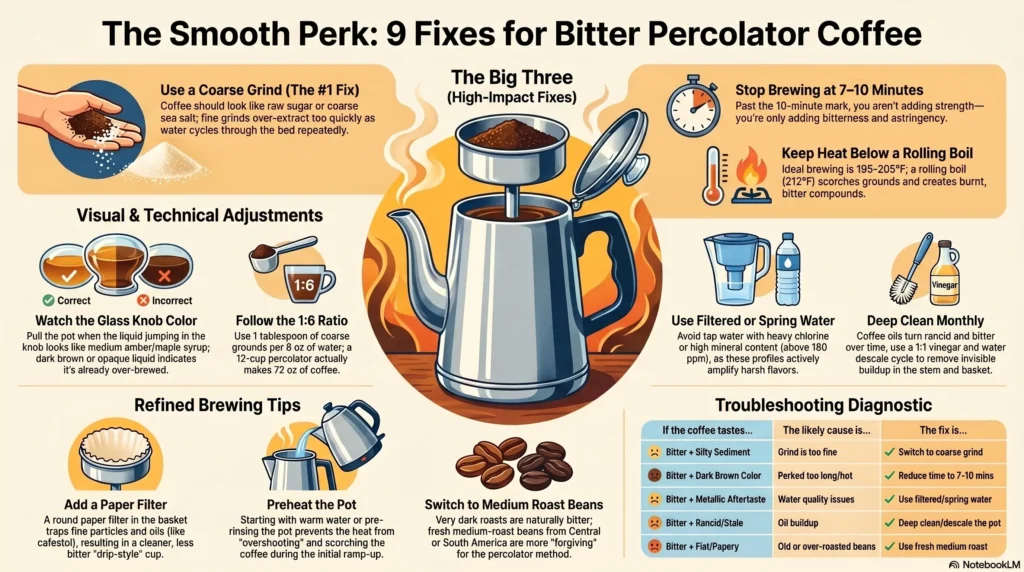
Target grind: coarse. It should look like raw sugar or coarse sea salt, not table salt.
Here’s how to dial it in with common grinders:
- Burr grinder (recommended): setting 28–32 on a Baratza Encore, or the two coarsest settings on most entry-level burr grinders.
- Blade grinder: pulse in short 2-second bursts for 8–10 seconds total, shaking the grinder halfway through. Blade grinders produce uneven particles, so err on the chunky side.
- Pre-ground coffee: bags labeled “percolator grind” or “coarse” (Café Bustelo, Dunkin’ Original) are usually safe bets.
For a full walkthrough with photos of each grind size, see our guide on how to grind coffee for a percolator.
Fix 2: Pull the pot off heat sooner than you think
Most people perk their coffee for too long. The advice you’ve probably heard “perk it for 10 minutes, maybe 15 if you want it strong” is how you get bitter coffee. Past the 10-minute mark, you’re not adding strength. You’re adding bitterness.
Target time: 7 to 10 minutes from the first perk.
The glass knob on top of your percolator is your gauge. Watch the color of the coffee jumping up into it:
- Pale amber: under-extracted. Keep going.
- Medium amber, the color of maple syrup: ideal. Pull it now.
- Dark brown, nearly opaque: you’re past peak. This batch will be bitter.
This is the skill that separates good percolator coffee from bad. See our dedicated post on how long to perk coffee in a percolator for a deeper walkthrough.
Fix 3: Keep the water just below a boil
The ideal brewing temperature for coffee is 195–205°F. A rolling boil is 212°F and past that threshold, you’re not extracting more flavor. You’re scorching the grounds and producing bitter, burnt-tasting compounds.
The problem: most percolator owners leave the heat cranked high because that’s how they got the perk started. Once perking begins, heat management becomes a game.
By stove type:
- Gas: once perking starts, cut the flame to the lowest steady setting that still produces a gentle, consistent perk one perk every 2–3 seconds.
- Electric coil: drop to medium-low the moment perking starts. Residual heat from coil burners is the enemy; consider sliding the pot off the burner briefly if it’s really cooking.
- Induction: set to 4–5 out of 10 once the first perk begins.
- Electric percolators: these control temperature automatically, so if yours runs hot, the other fixes matter more. Descaling (see Fix 6) often helps more than you’d expect.
Fix 4: Check your coffee-to-water ratio
People who want stronger coffee often dump in more grounds. Counterintuitively, this can make the cup more bitter, not stronger water forced through a packed bed of coffee extracts unevenly, pulling bitter compounds from the edges while under-extracting the center.
Target ratio: 1 tablespoon of coarse grounds per 6 oz of water.
In a percolator, a “cup” is 6 oz, not the 8 oz you’d expect. A 12-cup percolator makes 72 oz of coffee, not 96. Dose accordingly.
For the full breakdown by pot size, see our guide on coffee-to-water ratios in percolators.
Fix 5: Use filtered or bottled spring water
Coffee is 98% water. If your water tastes off, your coffee will too and certain water profiles actively amplify bitterness.
- Heavy chlorine: tap water in many US cities is chlorinated. Chlorine interacts with coffee compounds to produce sharper, harsher flavors.
- Very hard water: high mineral content (above 180 ppm total dissolved solids) over-extracts coffee.
- Very soft or distilled water: under-extracts and tastes flat, which some people mistake for bitterness.
Target: 50–150 ppm total dissolved solids. Most bottled spring water falls in this range. A basic Brita pitcher filters chlorine and moderates hardness for about $20.
Avoid distilled water entirely, it’ll make any coffee taste flat and strange.
Fix 6: Clean your percolator properly (coffee oils turn bitter over time)
This one surprises people: a dirty percolator is a common cause of bitter coffee, and the buildup isn’t always visible.
Coffee contains oils that coat the inside of the pot, the basket, the stem, and the spreader cap. Over time, those oils oxidize, they go rancid and every fresh pot you brew pulls that rancid-oil flavor into the cup. The result tastes bitter and stale.
Daily: rinse with hot water and a soft sponge after every use. Skip the dish soap, or rinse extremely thoroughly soap residue is another flavor killer.
Weekly: hand wash with a tiny amount of mild dish soap, rinsing until no film remains. Pay attention to the stem (inside and out) and the basket’s perforations.
Monthly: run a descale cycle with 1:1 white vinegar and water, followed by two plain-water cycles to rinse.
For step-by-step cleaning instructions, see our guides on cleaning a coffee percolator and cleaning an electric percolator.
Fix 7: Add a paper filter to the basket
A round paper filter cut to sit inside your percolator’s basket is the single easiest way to reduce bitterness without changing anything else about your brew.
Two things happen when you add a filter:
- Fine particles that would otherwise float in the cup and continue extracting get trapped.
- Most of the coffee oils (including cafestol, the compound that raises LDL cholesterol in unfiltered coffee) stay in the filter instead of your mug.
The trade-off: you lose a bit of body. The cup tastes cleaner, closer to drip-style coffee. If that’s the direction you’re heading anyway, it’s an easy win. See our post on whether you need a coffee filter for a percolator for more.
Fix 8: Preheat the pot
A cold pot on a cold burner takes longer to ramp up to brewing temperature and that long ramp-up overshoots on the way up. The water ends up hotter than the target before the thermal mass of the pot stabilizes.
Two easy preheats:
- Fill the pot with hot (not boiling) tap water before adding your measured brew water.
- Or, start with warm water instead of cold it cuts 2–3 minutes off the cycle and reduces heat overshoot.
This is a small fix, but on an electric stove with a slow-ramping coil, it’s the difference between a clean cup and a scorched one.
Fix 9: Switch roast or bean origin
Sometimes the beans are the problem, not your method.
Very dark roasts (French, Italian, “bold”) develop bitter compounds during the roasting process itself. No brewing technique can undo that. If you’re drinking a dark roast and fighting bitterness, switching to a medium roast often solves the problem immediately.
Single-origin Central and South American beans (Colombia, Guatemala, Brazil) at a medium roast tend to be naturally low-bitter and hold up well to percolator brewing.
Stale beans past about 4 weeks from the roast date develop a flat, papery bitterness as the oils oxidize. Check the roast date on the bag (not just the “best by” date) and buy smaller quantities more often.
For recommendations, see our guide on the best kind of coffee for a percolator.
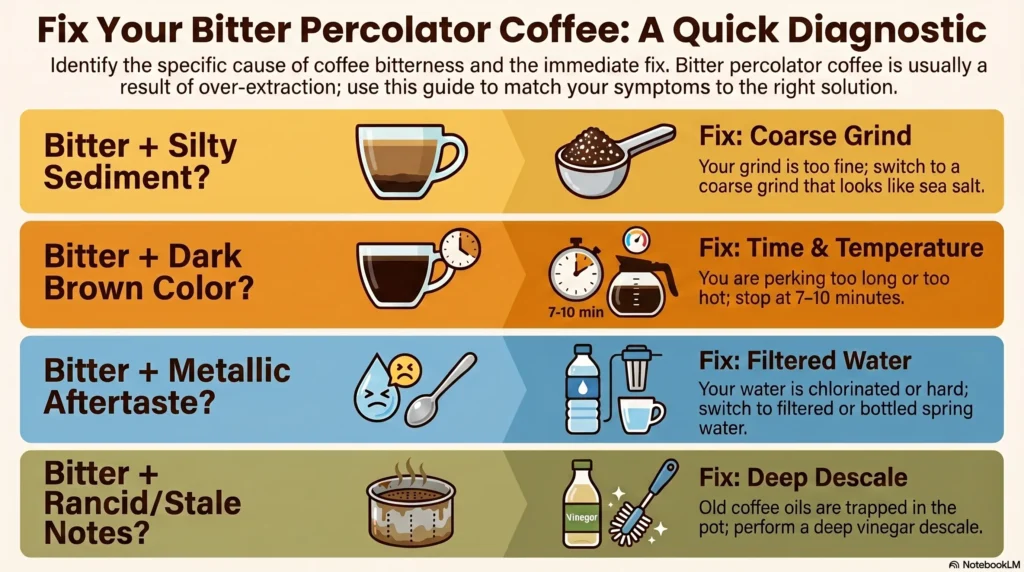
Quick diagnostic: what does your bitterness taste like?
Different bitterness flavors point to different causes. Use this table to skip straight to the right fix.
| Your symptom | Likely cause | Fix |
| Bitter + silty sediment at the bottom of the cup | Grind too fine | Fix 1: coarsen the grind |
| Bitter + dark brown perk color in the glass knob | Perked too long or too hot | Fixes 2 & 3: shorter time, lower heat |
| Bitter + chalky or metallic aftertaste | Hard or chlorinated water | Fix 5: switch water source |
| Bitter + rancid or stale note | Coffee oil buildup | Fix 6: deep clean the percolator |
| Bitter + flat, papery quality | Old beans or very dark roast | Fix 9: switch beans or roast |
| Bitter across the whole cup with no other notes | Too many grounds for the water volume | Fix 4: check the ratio |
When to stop troubleshooting and consider a different method
Here’s an honest truth most percolator guides won’t tell you: some people simply prefer coffee made a different way. If you’ve worked through all 9 fixes and the cup still isn’t what you want, the issue may not be technique. It may be preference.
- If you want brighter, tea-like coffee with clear origin notes: a pour-over or Chemex will get you there faster than a percolator ever will.
- If you want concentrated, espresso-style coffee without bitterness: a Moka pot or AeroPress is a better tool for the job.
- If you want consistency above all else: a good drip machine will outperform a percolator on forgiveness.
That said, a well-tuned percolator produces a cup you can’t really replicate with anything else full-bodied, robust, unmistakably coffee-forward. Work through the fixes above, and you’ll see what the method can really do.
Frequently asked questions
Why does percolator coffee always taste bitter?
Percolator coffee tastes bitter when it’s over-extracted when water has pulled too many compounds from the grounds. This usually comes from brewing too long (more than 10 minutes), brewing too hot (above 205°F), or using too fine a grind. A coarse grind, a 7–10 minute brew time, and heat just below boiling solve most bitterness issues.
Can you fix bitter coffee after it’s already brewed?
Partially. A pinch of salt (literally a pinch for a full pot) neutralizes perceived bitterness without making the coffee taste salty. Cream and sugar mask bitterness rather than fixing it. The reliable fix is preventing bitterness in the next pot, not rescuing the current one.
Is it okay to reuse percolator coffee grounds?
No. Used grounds have already given up their soluble flavor compounds but will still contribute bitterness on a second pass. Reused grounds produce a weak, harsh cup with none of the desirable notes. Compost them instead they’re excellent for garden soil.
How long should you let a percolator perk?
Seven to ten minutes from the first perk is the sweet spot for most percolators. Watch the color of the coffee jumping into the glass knob: pull the pot when it reaches a medium amber color, like maple syrup. Dark brown means you’ve gone too long.
Does adding salt to percolator coffee reduce bitterness?
Yes, a small pinch of salt (about 1/8 teaspoon for a 12-cup pot) neutralizes some of the bitter-tasting compounds on the tongue. It’s an old Scandinavian trick that actually works. That said, it treats the symptom the real fix is adjusting your grind, time, and temperature.
The bottom line
Bitter percolator coffee is a technique problem, not a flaw in the brewing method. A coarser grind, a shorter brew time, and better heat control will fix the issue for most people on the very next pot. A cleaner percolator, better water, and the right roast fix it for almost everyone else.
Work through the fixes in order. Start with the grind and the timing those two changes alone solve somewhere in the neighborhood of 80% of bitterness problems. The rest are refinements that take a good cup and make it great.