Percolator vs. Moka Pot: Which Brews Better Coffee?


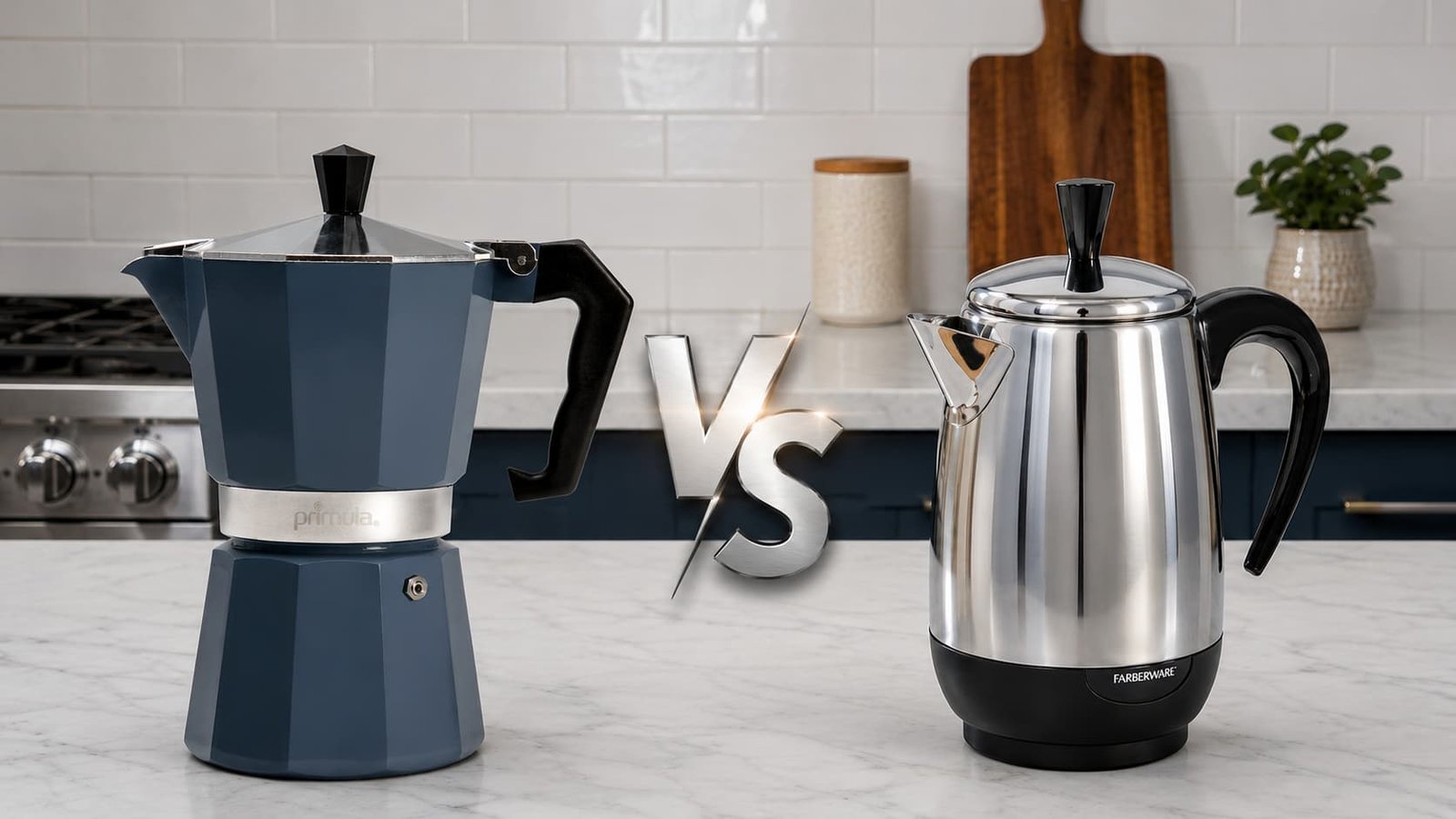
If you’re stuck choosing between a Percolator vs. Moka Pot, here’s the truth: they’re not two versions of the same thing.
One delivers big, bold mugs of coffee. The other pulls small, espresso-style shots packed with intensity. Same stovetop completely different brew.
Below, we’ll compare taste, strength, ease of use, and value so you can pick the right one with confidence.
| THE SHORT ANSWER Pick a percolator if you want a full pot of drip-strength coffee 8 to 12 cups of medium-bodied brew for the household. Pick a Moka pot if you want 2 to 4 ounces of concentrated, espresso-style coffee for one or two people. The core difference is mechanical: percolators recirculate water over the grounds; Moka pots use steam pressure to push water through them once. |
How each one works (the brewing principle)
Most comparison articles get this wrong or skip it entirely, and that’s why the rest of their advice tends to fall apart. The mechanical difference between these two brewers isn’t a detail. It’s the whole story.
The percolator: recirculation
A percolator has three parts: the pot (bottom chamber), a basket that sits at the top holding the coffee grounds, and a hollow stem that connects them.
You fill the pot with water, put coarse grounds in the basket, and apply heat. When the water boils, pressure pushes a small amount of it up through the hollow stem, where it sprays out onto the grounds and drips back down into the pot.
That newly brewed coffee then gets heated, pushed up the stem, and sprayed over the grounds again. And again. The cycle repeats for 7 to 10 minutes.
The result: a full pot of coffee, brewed under ambient pressure and driven by gravity and convection. Because the same water passes over the grounds repeatedly, percolators produce strong, full-bodied coffee at drip-like volumes.
The Moka pot: pressure extraction
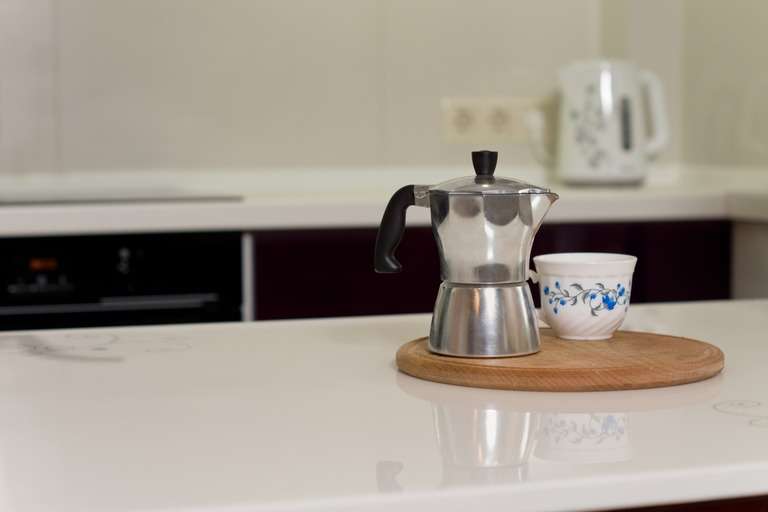
A Moka pot also has three parts, but they’re arranged differently: a bottom water chamber, a funnel-shaped basket that packs fine grounds, and a top chamber that collects the finished coffee.
You fill the bottom with water, pack the basket with fine grounds, screw the top chamber on, and apply heat. As the water in the bottom chamber heats up, steam pressure builds roughly 1 to 2 bar and that pressure forces hot water up through the packed puck of coffee, into the top chamber, where it stays.
The result: 2 to 4 ounces of concentrated coffee, brewed under moderate pressure in a single pass.
Because the water only passes through the grounds once, and because the extraction is pressure-driven through a dense bed, Moka pots produce thick, syrupy, espresso-adjacent coffee at espresso-like volumes.
| WHY THIS MATTERS If a friend tells you a Moka pot makes espresso, they’re half-right and half-wrong. Real espresso machines operate at 9 bar five to nine times the pressure of a Moka pot. The Moka produces something in the family, but it’s its own thing. Same for percolators: people call them ‘old-fashioned drip,’ but drip machines single-pass too. Percolators are genuinely different from both. |
Flavor profile: what each one actually tastes like
Most articles stop at “bold and rich.” That’s not useful. Here’s what you’ll actually taste in the cup.
Percolator flavor signature
- Body: heavier than drip, lighter than espresso. Oils pass through into the cup (unless you add a paper filter), which gives it a round, coating mouthfeel.
- Roast character: medium and dark roasts shine. You’ll taste chocolate, toasted nuts, caramelized sugar, and a pronounced roasty quality.
- Acidity: muted. The high brew temperature and extended contact time soften bright, fruity acids. Great news if you find pour-over coffee too sharp; less great if you love a bright Ethiopian.
- Finish: long and full. The aftertaste lingers in a way that pairs well with cream and sugar.
- Common compared-to: diner coffee, campfire coffee, your grandmother’s kitchen on Sunday morning. Which, depending on your mood, is either a feature or a reason to pick something else.
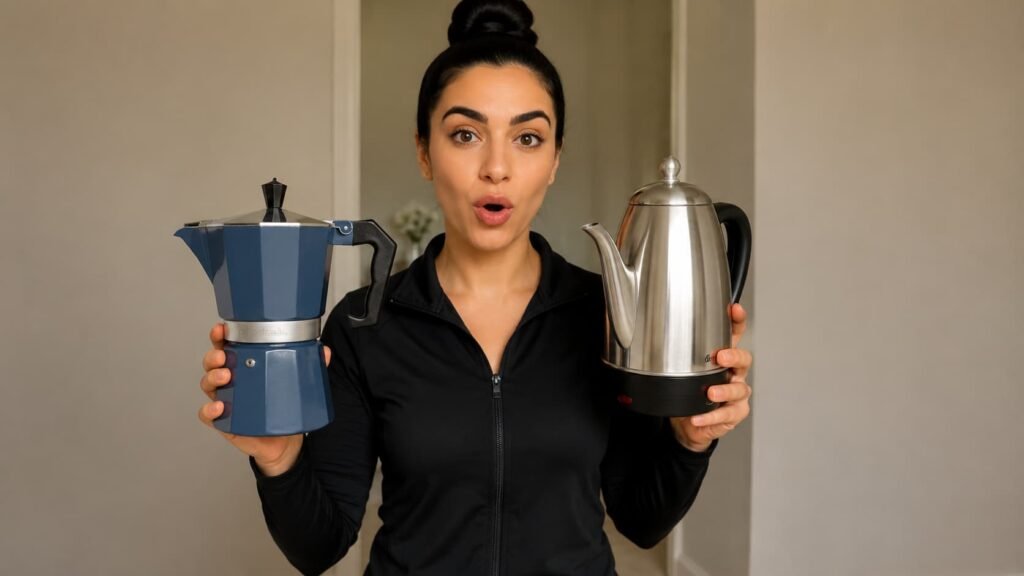
Moka pot flavor signature
- Body: thick and syrupy. The fine grind and pressure pull out oils and fine particulates that make the cup feel almost viscous.
- Roast character: medium-dark to dark roasts work best. You’ll get intense bittersweet chocolate, dark caramel, and a hint of smoke. Light roasts can taste sharp and metallic.
- Acidity: present but concentrated. Because you’re working with such a small volume, any acidity hits harder than it would in a larger cup.
- Finish: short and intense, then a lingering bittersweet note.
- Common compared-to: Italian café coffee, a cortado without the milk, espresso’s rustic cousin. Not quite espresso no real crema, less concentrated but unmistakably in that family.
Side-by-side comparison
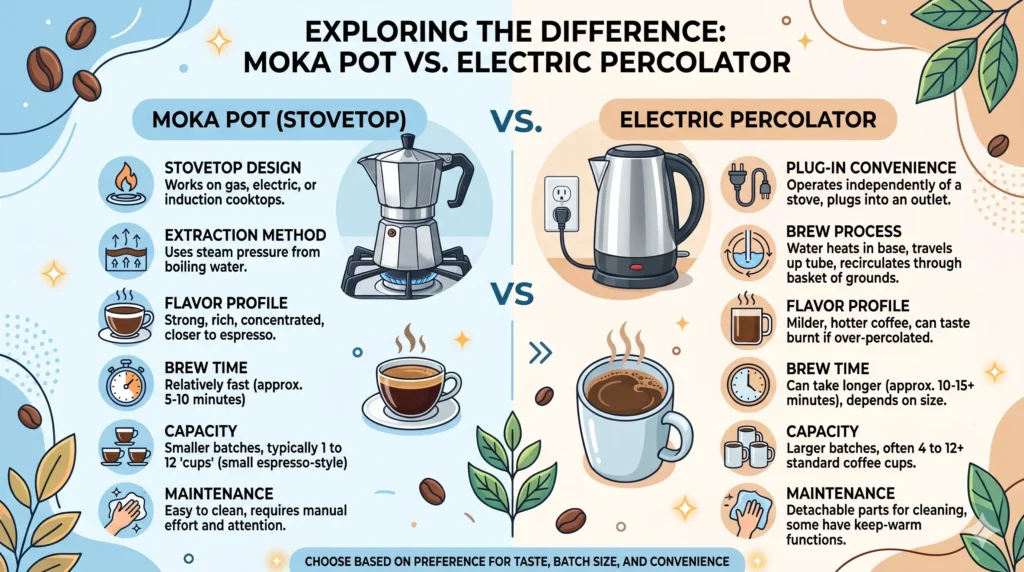
| Feature | Percolator | Moka Pot |
| Brewing principle | Recirculation at ambient pressure | Single-pass under 1–2 bar pressure |
| Brew time | 7–10 minutes | 4–5 minutes |
| Output volume | 8–12 cups (48–72 oz) | 2–4 oz for a 3-cup model |
| Grind size | Coarse (sea salt) | Fine (finer than drip, coarser than espresso) |
| Concentration | Medium | Very high |
| Crema | None | Minimal (not real espresso crema) |
| Cost range | $25–$150 | $25–$100 |
| Best for | Households, gatherings, camping | 1–2 people, milk drinks, espresso lovers |
| Learning curve | Forgiving on grind, strict on time | Forgiving on time, strict on grind and heat |
| Cleanup | 4–5 parts, rinse and occasional descale | 3 parts, no soap on aluminum, gasket replaces yearly |
| Induction compatible | Depends on model (stainless only) | Only specific induction-ready models |
| Works off-grid | Yes (stovetop or campfire) | Yes (any heat source) |
Brew time and capacity: how much coffee, how fast?
This is where the practical difference shows up in your actual kitchen.
A percolator takes about 7–10 minutes to brew a full pot — typically 8 to 12 cups. You’re feeding a family, a dinner party, or an all-day supply. The trade-off is you wait longer and end up with more coffee than one person can drink fresh.
A Moka pot takes about 4–5 minutes to brew 2–4 ounces (a 3-cup Bialetti makes about 5 oz total). You’re making coffee for yourself, or for yourself and one other person. If you need more, you brew a second round.
Practical implication: if you host, entertain, or live with more than one coffee drinker, a percolator probably makes more sense. If you live alone or share with one other person who might want espresso drinks, the Moka pot is built for your situation.
Grind size and beans: don’t use the wrong grind
This is the single most common reason people think their new brewer is broken. The two methods need genuinely different grinds.
Percolator: coarse
You want coffee that looks like raw sugar or coarse sea salt. Finer grinds slip through the basket holes, over-extract under recirculating water, and produce bitter, silty coffee. See our guide on how to grind coffee for a percolator for the full breakdown.
Moka pot: fine
You want coffee that’s finer than drip grind but not quite espresso-fine. It should feel like granulated sugar or fine sand — gritty between the fingers but not powdery. A fine grind creates the dense, even puck that pressure can build against.
On roast and beans
Both methods do their best work with medium to dark roasts. Very light roasts will taste sour in a percolator and sharp in a Moka pot. Both methods reward origin beans with strong body — Brazilian, Sumatran, and espresso blends are common favorites. Save the delicate Ethiopian Yirgacheffe for a pour-over.
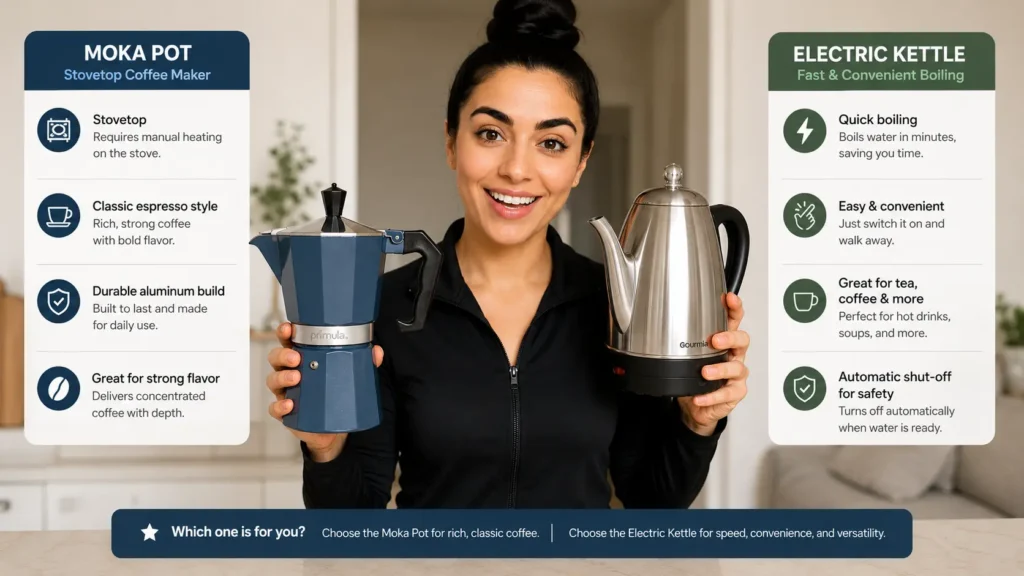
Cost and long-term value
Both brewers are genuinely affordable for what they do, and both are generational purchases when you buy well.
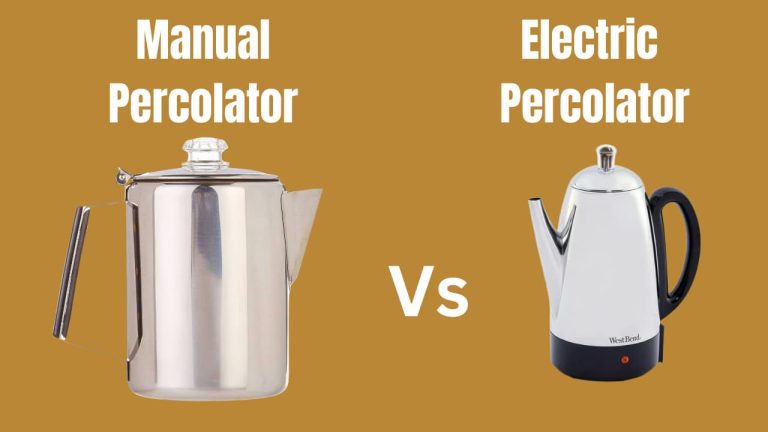
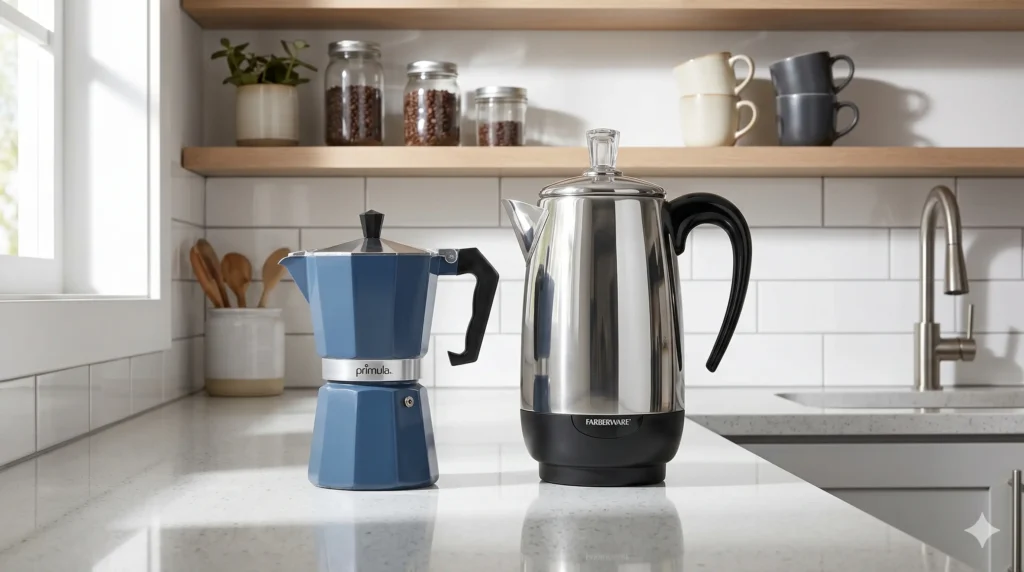
- Stovetop percolators: $25–$80 for a solid stainless steel model like a Farberware Yosemite or Medelco glass percolator. Camping models run $25–$50.
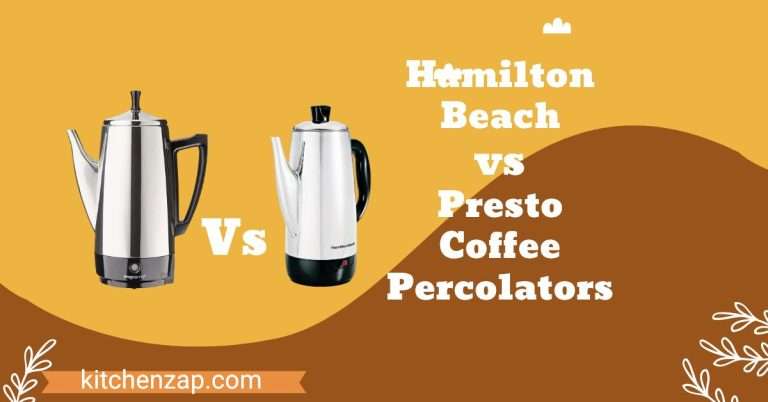
- Electric percolators: $40–$150. Presto and Hamilton Beach dominate the budget-to-midrange; Cuisinart is the premium pick.
- Moka pots: $25–$60 gets you a Bialetti Moka Express, which is the default and absolutely fine. Premium stainless options (Alessi, Bialetti Venus) run $70–$120.
Either way, you’re looking at decades of use if you treat the hardware well. A well-maintained Farberware percolator or Bialetti Moka Express routinely outlasts the owner. That’s a $30–$60 purchase that’ll still be brewing coffee in 2050.
Ease of use and learning curve
Both methods are beginner-friendly with one notable pitfall each.
Percolator: the time pitfall
Percolators are forgiving on grind (coarse-ish is fine) and forgiving on heat level (any steady heat works). The trap is time. Left too long on the heat, they produce bitter, over-extracted coffee. The skill to develop is reading the color of coffee jumping into the glass knob and pulling the pot at the right moment.
Moka pot: the grind and heat pitfall
Moka pots stop extracting on their own once the bottom chamber empties, so time isn’t really an issue. What’s fussy is the grind (wrong grind = weak or bitter coffee, no middle ground) and the heat level (too high = burnt, too low = doesn’t brew). Once you dial in both, it’s remarkably consistent.
For absolute beginners: a percolator has the slightly gentler learning curve. There’s one skill to learn (timing) versus two for the Moka pot (grind and heat).
Cleanup and maintenance
Percolator
Disassembles into 4 or 5 parts (pot, basket, stem, spreader, sometimes a cap). Rinse each part with hot water after use. Avoid dish soap where possible, or rinse aggressively — soap residue carries over to the next brew. Monthly, run a 1:1 vinegar-and-water cycle to descale.
Moka pot
Disassembles into 3 parts (bottom chamber, funnel basket, top chamber). Aluminum Moka pots shouldn’t be scrubbed with soap or abrasive sponges the interior develops a seasoned patina that actually improves the coffee, and soap strips it. Stainless Moka pots tolerate soap just fine.
The rubber gasket at the top chamber needs replacing every 1 to 2 years (they’re $3–$5 and universal by size). If your coffee suddenly tastes off or you hear more hissing than usual, that’s the gasket.
Neither is dishwasher-safe as a general rule. Hand wash both for best results.
Who should buy which? A decision framework
Buy a percolator if…
- You brew for two or more people regularly.
- You want a drip-style cup with more body and less acidity.
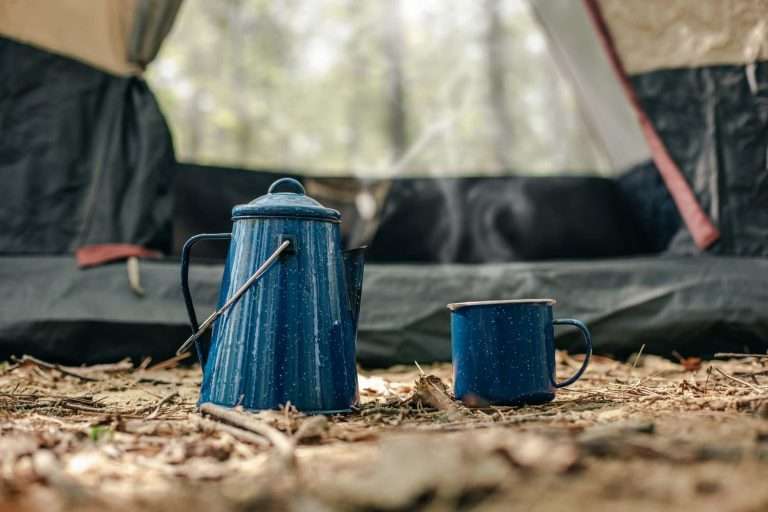
- You camp, RV, or want a brewer that works during a power outage.
- You like a hands-off workflow — set it on the stove, check the knob, pour.
- You take your coffee black or with just a splash of cream.
Buy a Moka pot if…
- You drink espresso-style, concentrated coffee.
- You make milk drinks — cappuccino, cortado, flat white, latte.
- You brew for one person, or two who both want small cups.
- You enjoy dialing in a brewing ritual and adjusting for the beans you’re using.
- You want a countertop-friendly, single-purpose tool without electronics to fail.
Buy both if…
If you have the counter space and the budget, they genuinely serve different coffee moments. A percolator handles the 7am pot for the household and weekend brunch; a Moka pot handles the afternoon cappuccino and the 3pm pick-me-up. Combined, they cover most of what a home espresso setup does, at a fraction of the price.
Common misconceptions
Moka pots make espresso
Not quite. Real espresso extracts at 9 bar of pressure. A Moka pot extracts at 1 to 2 bar. The drink that comes out is concentrated and intense, but it lacks the emulsified crema layer and the syrupy density of a true espresso shot. Call it “espresso-style” or “Moka coffee” and you’ll be technically accurate.
“Percolators always burn coffee”
They don’t, if you use them right. Percolators burn coffee when they’re left too long on too much heat with too fine a grind. Fix any one of those three variables and the result is clean and well-balanced. See our full guide on how to make percolator coffee not bitter for the mechanics.
“A Moka pot is just a pressurized percolator”
No — and this is worth understanding if you’re choosing between them. A percolator recirculates water over the grounds repeatedly at ambient pressure. A Moka pot pushes water through the grounds once under pressure. The brewing physics are genuinely different, which is why the cups taste so different.
Frequently asked questions
Is a Moka pot stronger than a percolator?
By concentration, yes significantly. A Moka pot produces 2–4 ounces of very concentrated coffee, so ounce-for-ounce it’s much stronger than a percolator’s medium-bodied brew. By total caffeine per serving, it depends: a typical Moka shot has about 80 mg of caffeine, while an 8-ounce cup of percolator coffee runs 120–200 mg. You just drink less Moka.
Can you use percolator grind in a Moka pot?
No — a coarse percolator grind is far too coarse for a Moka pot. You’d end up with weak, watery coffee because the pressure can’t build against a loose bed of large particles. Moka pots need a fine grind, finer than drip but coarser than espresso.
Which is healthier, percolator or Moka pot coffee?
Both are unfiltered brewing methods, meaning both pass cafestol and kahweol (compounds that can raise LDL cholesterol) into the cup. In that sense, they’re similar. Adding a paper filter to a percolator basket removes most of these compounds; there’s no equivalent option for a Moka pot. If cholesterol is a concern, a percolator with a paper filter wins.
Do Moka pots and percolators work on induction stoves?
Only if the brewer has a magnetic base. Most aluminum Moka pots don’t — you need a stainless steel Moka pot or an induction adapter plate. Percolators vary: stainless models usually work, aluminum and glass models don’t. Check the product description before buying if you’re on induction.
Which lasts longer, a Moka pot or a percolator?
Both can last decades with basic care. A stainless steel percolator has essentially no wear parts and often outlasts its owner. A Moka pot needs its rubber gasket replaced every 1–2 years ($3–$5) and the filter plate every 5 years or so; the body itself lasts effectively forever. Neither is a short-term purchase.
The bottom line
Percolator or Moka pot isn’t really the right question. The right question is: what kind of coffee do you actually want to drink?
If the answer is a full pot of medium-bodied, robust coffee for the household and the occasional camping trip, a percolator is your tool. If the answer is a small, concentrated shot for espresso drinks or a quick pick-me-up, a Moka pot is your tool. Neither is “better” than the other. They’re answering different questions.
And if you’re still torn — buy both. Between them, you’ll cover about 80% of what a $600 home espresso setup does, and you’ll spend less than $100 total. Explore our full percolator guide library if you want to dig further into either method.