French Press Coffee Like Starbucks: Easy Copycat Method

Making French press coffee like Starbucks at home is easier than you think. Starbucks publishes its own French press method, so you can make the rich, full-bodied cup you pay extra for in-store on your own kitchen counter.
This guide breaks down the official ratio, grind size, and steep time, plus a few flavor tricks to get your brew as close to the cafe version as possible.
Key Takeaways
- Starbucks specifies a coarse grind, a 2-tablespoon-per-6-ounce water ratio, and a strict 4-minute steep for French press coffee.
- Water temperature should sit between 195 and 205 degrees Fahrenheit, just off a full boil.
- Decanting immediately after pressing prevents over-extraction and the bitter finish that ruins many home brews.
- The same core method applies to both Starbucks Reserve and standard Starbucks beans, with minor strength adjustments
- A cold-brew French press variant follows the same bean-and-grind logic but uses cold water and a steep of about 12 hours
The Core Starbucks French Press Parameters
Starbucks frames the French press as its preferred home-brewing method because full immersion keeps the coffee’s natural oils in the cup rather than trapping them in a paper filter.
Those oils carry body, aroma, and the slightly silky texture that distinguishes a French press from drip coffee. Understanding the four non-negotiable parameters below is the starting point for any copycat attempt.
Grind Size
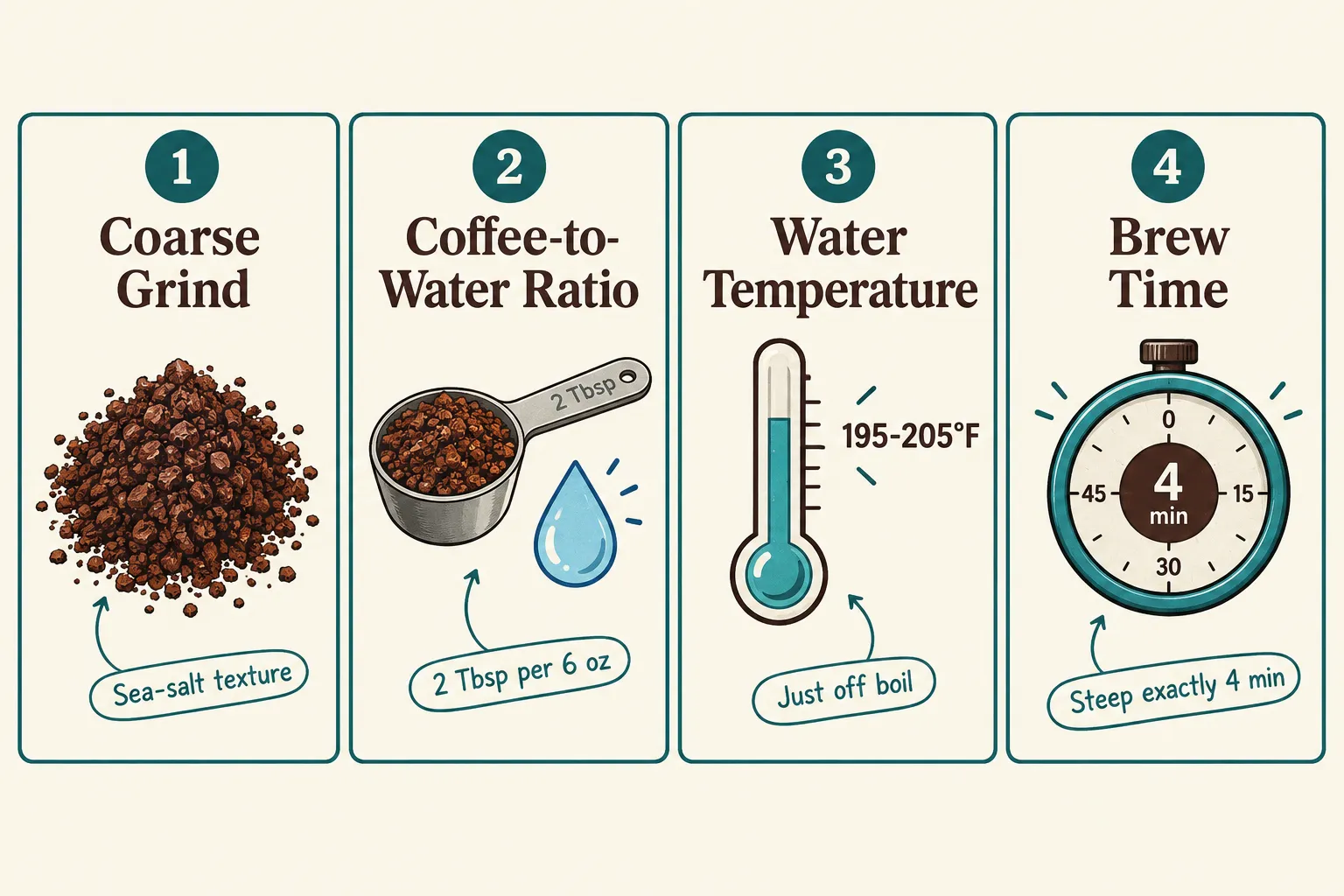
Coarse grind is non-negotiable. Starbucks describes the ideal particle size as resembling coarse sea salt. A fine or medium grind will pass through the metal mesh plunger, cloud the cup, and over-extract during the steep, producing harsh bitterness.
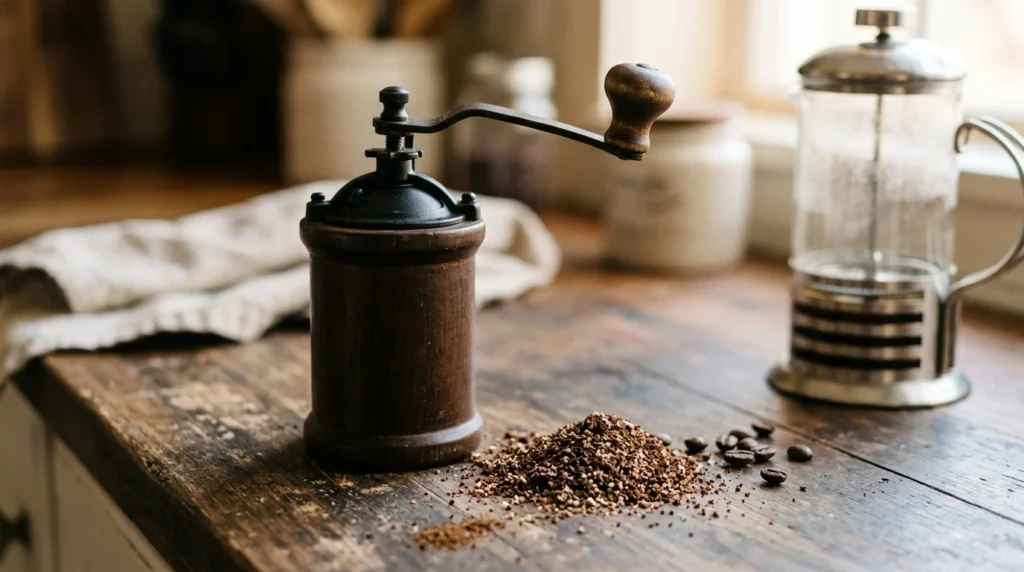
If grinding at home, set a burr grinder to its coarsest setting and verify the texture by feel before brewing.
The guide on how to grind coffee for a French press shows exactly what that texture should look like. For a deeper look at how grind size affects flavor, see this guide on types of coffee grind.
Coffee-to-Water Ratio
Starbucks’ own coffee press method calls for 2 tablespoons (approximately 10 grams) of ground coffee per 6 ounces of water. Scaled to a standard 32-ounce (4-cup) French press, that works out to roughly 10 to 11 tablespoons, or about 55 grams of grounds.
This ratio produces a medium-strong cup that mirrors what Starbucks serves in-store. Adjusting up by one tablespoon per 6 ounces yields a bolder, Starbucks Reserve-style strength. For the same math at every press size, see the French press coffee water ratio guide.
Tip: The French press is one of the purest ways to brew coffee. Nothing filters out the oils, so the flavor of the bean comes through on its own.
Water Temperature
Water that is still boiling (212 degrees Fahrenheit) scorches the grounds and produces a harsh, flat cup. Starbucks recommends pulling water off the heat and waiting 30 seconds, landing in the 195-to-205-degree range. A simple thermometer removes the guesswork, but the 30-second rest rule is a reliable shortcut.
Brew Time
Four minutes is the Starbucks standard, not three, not five. Under four minutes leaves the brew weak and under-developed. Over four minutes tips the cup into over-extracted bitterness. Setting a timer the moment the lid goes on is the single easiest habit that separates a good home brew from a great one.
Starbucks French Press Parameters at a Glance
| Parameter | Starbucks Standard |
|---|---|
| Grind size | Coarse (sea-salt texture) |
| Coffee-to-water ratio | 2 Tbsp per 6 oz water |
| Water temperature | 195 to 205 degrees F |
| Steep time | 4 minutes exactly |
| Serving | Decant immediately after pressing |
Step-by-Step: How to Make French Press Coffee Like Starbucks
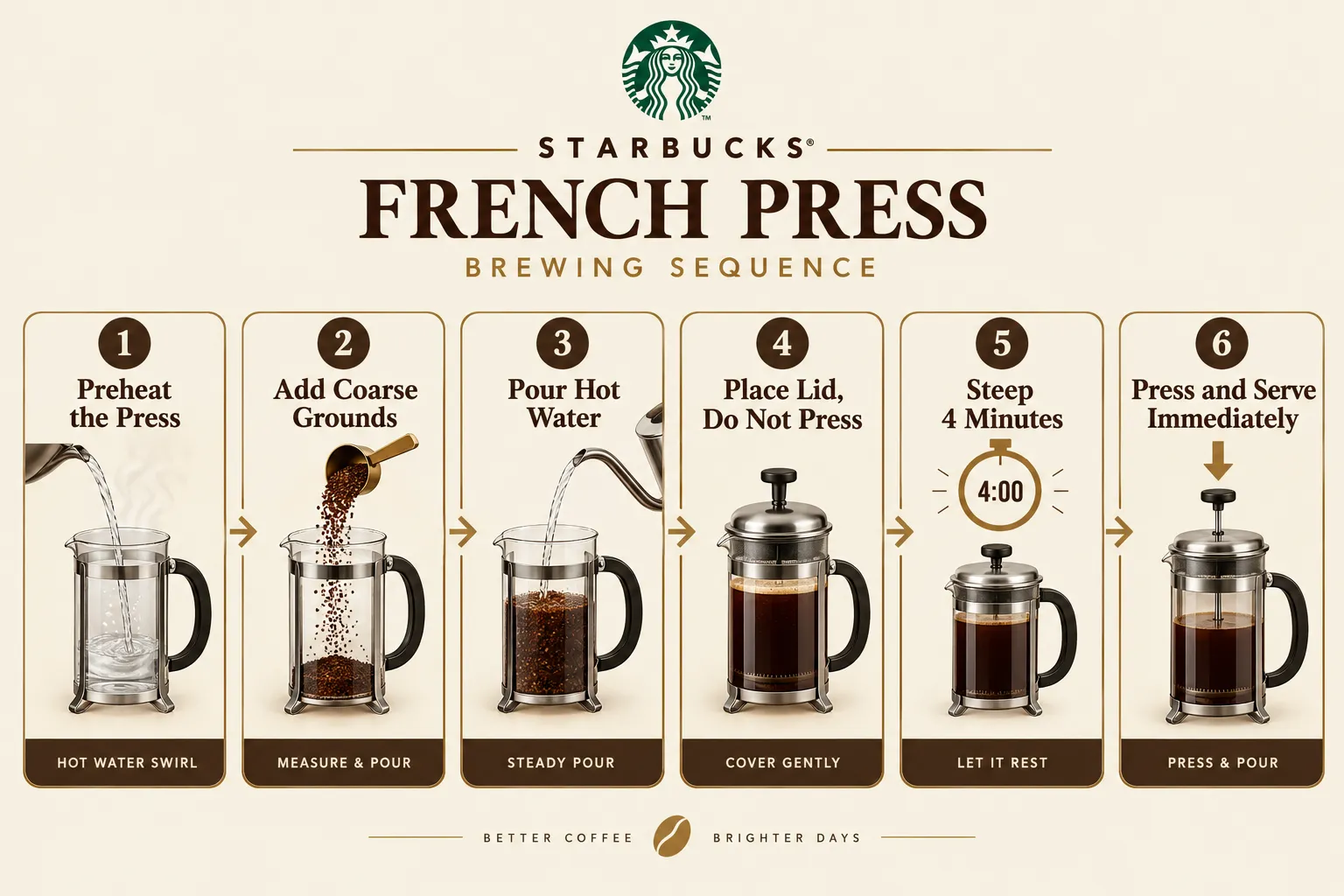
Following the Starbucks method precisely is straightforward once the parameters above are locked in. The steps below mirror the official Starbucks at Home coffee press guide and the Starbucks Reserve Coffee Press Brew Guide, with practical notes added for home brewers.
Step 1, Preheat the French Press
Pour hot water into the empty carafe, swirl it around, and discard. Preheating stabilizes the brewing temperature and prevents the glass or stainless-steel body from pulling heat away from the grounds during the steep.
This step is often skipped and almost always worth doing, especially in a standard glass press. For those who want to retain heat even better, a double-walled French press coffee maker eliminates the need for preheating entirely.
Step 2, Measure and Add Grounds
Add coarsely ground coffee at the 2-tablespoon-per-6-ounce ratio. For a standard 32-ounce press, that means roughly 10 to 11 tablespoons. Use a kitchen scale for consistency, 55 grams of coarse grounds for a 32-ounce press is more repeatable than tablespoon counting, which varies with grind density.
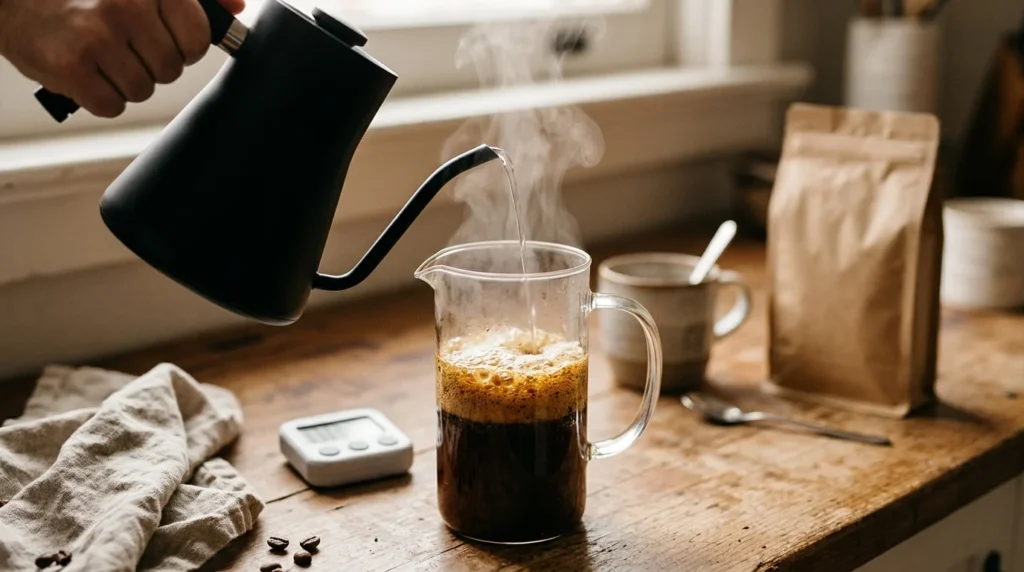
Step 3, Pour Hot Water
Start a timer and pour water heated to 195-to-205 degrees Fahrenheit over the grounds in a slow, even spiral. The goal is to saturate all the grounds evenly. Starbucks recommends filling to just below the top of the metal frame that holds the lid. Stir gently once to ensure no dry clumps remain at the bottom.
Step 4, Place the Lid, Do Not Press Yet
Set the lid on top with the plunger pulled all the way up. Do not press down. The closed lid traps heat and prevents aromatic compounds from escaping during the steep. Pressing early disrupts the immersion process and compresses the grounds before extraction is complete.
Step 5, Steep for Exactly 4 Minutes
Let the timer run to four minutes without disturbing the press. This is where the full-immersion magic happens, the grounds release oils, sugars, and flavor compounds that paper-filtered methods cannot capture.
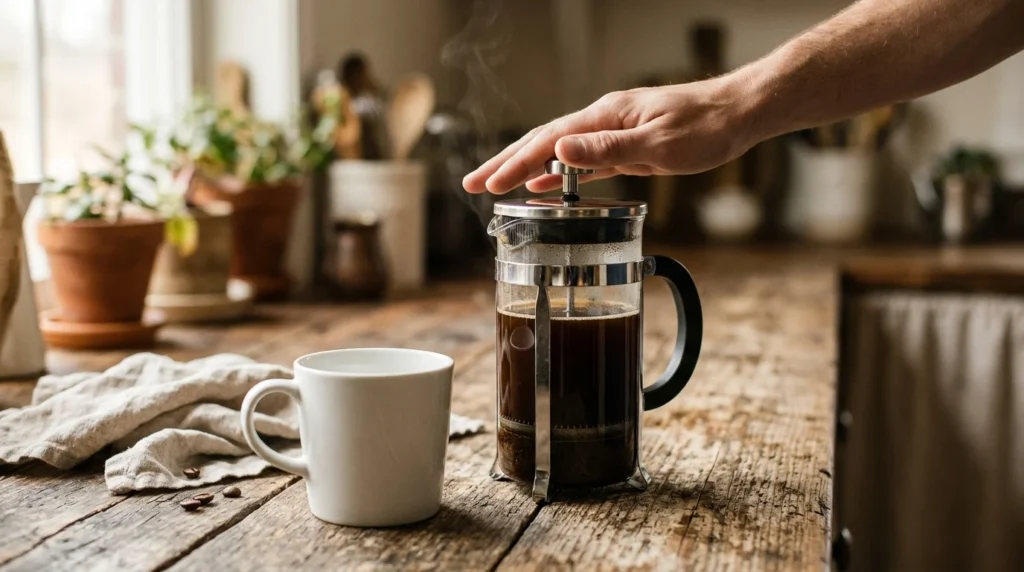
Step 6, Press Slowly and Serve Immediately
Apply steady, even downward pressure on the plunger over about 20 to 30 seconds. Forcing it quickly can push fine particles through the mesh.
Once fully pressed, pour the coffee into cups or a thermal carafe right away. Leaving brewed coffee sitting on the grounds, even with the plunger down, continues extraction and turns the cup bitter within minutes.
For troubleshooting common issues like silt in the cup or weak flavor, the French press coffee troubleshooting guide covers the most frequent problems and their fixes.
Copycat Recipes: Replicating Starbucks Flavors at Home
Starbucks builds its signature French press drinks on the base brew above, then layers in specific beans, syrups, and serving styles. The recipes below replicate the most popular Starbucks French press experiences.

Classic Starbucks-Style Dark Roast French Press
- Beans: Starbucks Sumatra, Pike Place Roast, or Caffè Verona (all available retail)
- Ratio: 2 Tbsp coarse grounds per 6 oz water
- Steep: 4 minutes at 200 degrees F
- Serve: Black, or with a splash of whole milk
Starbucks Sumatra delivers the earthy, full-bodied profile most associated with in-store Starbucks. Pike Place is milder and more balanced, closer to the everyday drip experience but with noticeably more body from the French press method.
Starbucks Reserve-Style Single-Origin Press
The Starbucks Reserve program uses the same French press method but bumps the ratio slightly to 2.5 tablespoons per 6 ounces for a more concentrated, nuanced cup. Reserve beans, often single-origin lots from Ethiopia, Colombia, or Guatemala, express brighter fruit and floral notes at this slightly stronger ratio. The 4-minute steep and 200-degree water temperature remain unchanged.
Vanilla Sweet Cream French Press
This copycat mirrors the flavor profile of Starbucks’ sweet cream drinks:
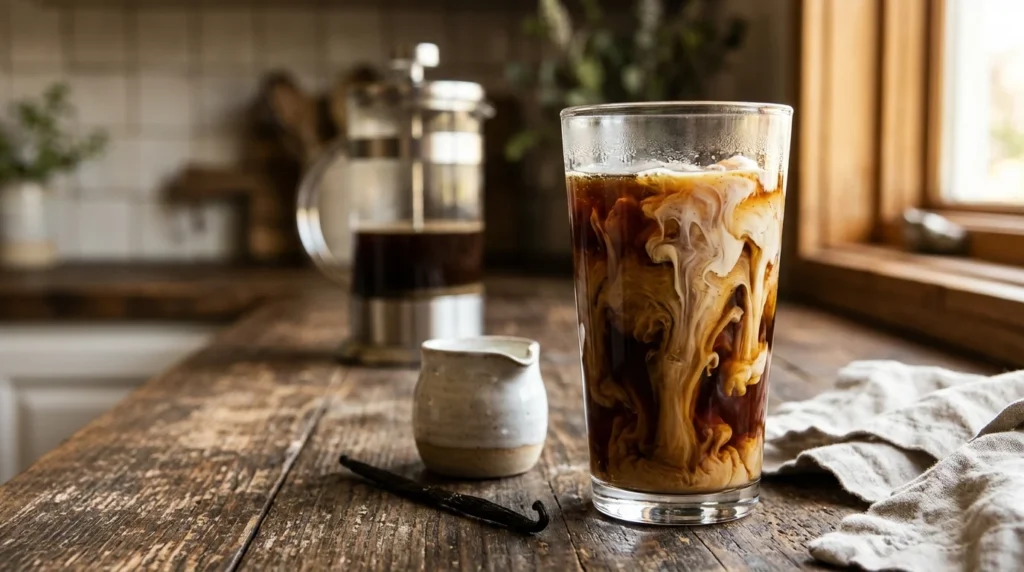
- Brew a standard dark roast French press as described above
- Stir in 1 to 2 pumps of vanilla syrup (about 1/2 teaspoon per pump) while hot
- Top with a 2-tablespoon float of cold heavy cream
- Do not stir, let the cream cascade through the coffee
For those who want to go further with flavored syrups, the guide on making coffee syrups at home covers vanilla, caramel, hazelnut, and more with simple pantry ingredients. For a seasonal Starbucks copycat, try this homemade peppermint mocha.
Starbucks-Style Cold Brew French Press Variant
Starbucks’ at Home cold brew guide adapts the French press for cold extraction:
- Use the same coarse grind and Starbucks beans
- Combine 4 tablespoons of coarse grounds for every 6 ounces of cold or room-temperature water in the French press
- Stir, place the lid on (plunger up), and leave it to steep for about 12 hours
- Press slowly and serve over ice
The result is a smooth, low-acid concentrate that mirrors the Starbucks cold brew flavor profile without a dedicated cold brew maker. For a side-by-side look at how French press cold brew compares to dedicated cold brew equipment, see this French press cold brew recipe and comparison.
Common Mistakes That Break the Starbucks Result
Even with the right beans and ratios, small errors consistently derail the final cup. The table below summarizes the most frequent problems and their direct fixes.
| Mistake | Effect on Cup | Fix |
|---|---|---|
| Grind too fine | Silt, over-extraction, bitterness | Reset grinder to coarse; verify sea-salt texture |
| Water too hot (boiling) | Scorched, flat, harsh flavor | Rest 30 seconds off boil |
| Steep over 4 minutes | Bitter, astringent finish | Use a timer every brew |
| Not decanting immediately | Continued extraction after pressing | Pour into a thermal carafe right away |
| Under-dosing grounds | Weak, watery cup | Measure by weight (55 g per 32 oz) |
If bitterness is a recurring problem despite following the steps above, the detailed breakdown of why French press coffee turns bitter identifies ten specific causes and solutions. For those new to the method entirely, the beginners guide to French press coffee questions answers the most common setup and technique questions.
Choosing the Right Beans for a Starbucks-Style Brew
Bean selection is the variable that most separates a genuine Starbucks copycat from a generic French press. Starbucks uses 100% arabica beans across its entire retail line, roasted to a medium-dark or dark profile for most of its flagship products. The key retail options and their flavor profiles are:
- Starbucks Sumatra: Earthy, full-bodied, low acidity, the most “Starbucks” of all options
- Caffè Verona: Dark chocolate and caramel notes, smooth finish
- Pike Place Roast: Balanced medium roast, subtle cocoa and toasted nut
- Starbucks Espresso Roast: Intense, caramelly, works well at the Reserve ratio
If you want options beyond the Starbucks lineup, these whole coffee beans for French press work well with the same method. For those who prefer to avoid caffeine without sacrificing flavor, the guide to the best decaf coffee for French press identifies decaf options that hold up to the Starbucks method’s full-immersion extraction.
Conclusion
Replicating Starbucks-style French press coffee at home comes down to four controllable variables: coarse grind, a 2-tablespoon-per-6-ounce ratio, water at 195-to-205 degrees, and a precise 4-minute steep followed by immediate decanting.
None of these steps require expensive equipment: a quality burr grinder, a kitchen thermometer, and a standard French press are sufficient. The guide to French press coffee accessories covers the tools worth adding next.
Actionable next steps for 2026:
- Purchase Starbucks Sumatra or Caffè Verona whole beans and grind them coarse on brew day for maximum freshness
- Invest in a kitchen scale and set it to grams, 55 grams per 32-ounce press removes ratio guesswork permanently
- Try the cold brew variant on a weekend and compare it side-by-side with the hot method to understand how immersion time changes the flavor profile
- Explore 20 café-style French press coffee recipes to expand beyond the base brew once the core technique is consistent
The Starbucks method is not a trade secret. It is a disciplined, repeatable process that rewards attention to detail. Apply it consistently and the gap between home brew and in-store quality closes faster than most coffee drinkers expect.