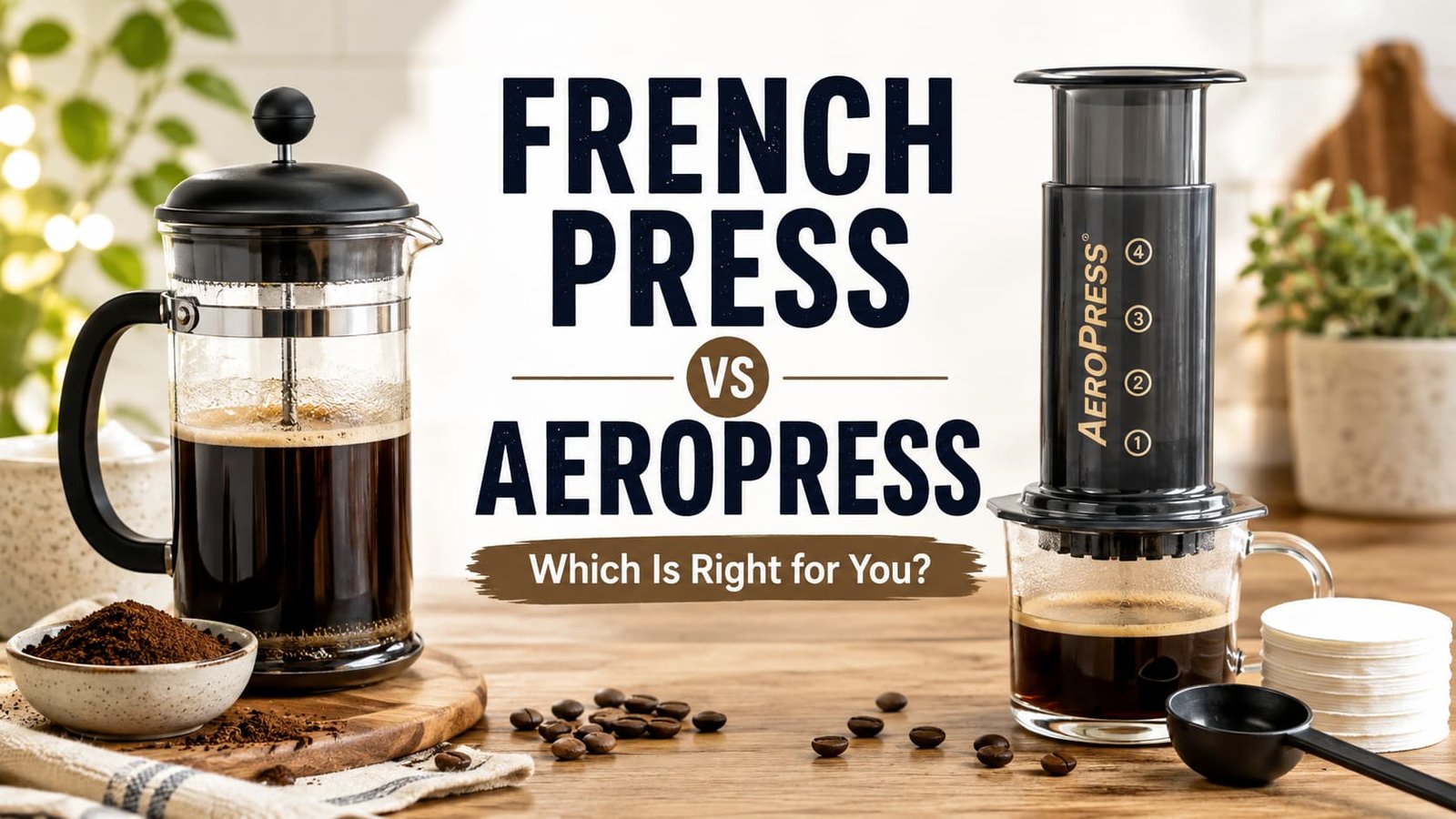
French Press vs AeroPress: Which Is Right for You?

If you have ever stood in the coffee aisle deciding between a french press vs aeropress, the honest answer is that neither one is objectively better.
They are built around different brewing mechanisms, and that difference is what actually separates the two cups you end up drinking. Once you understand how each one extracts coffee, the choice tends to make itself.
The Quick Answer
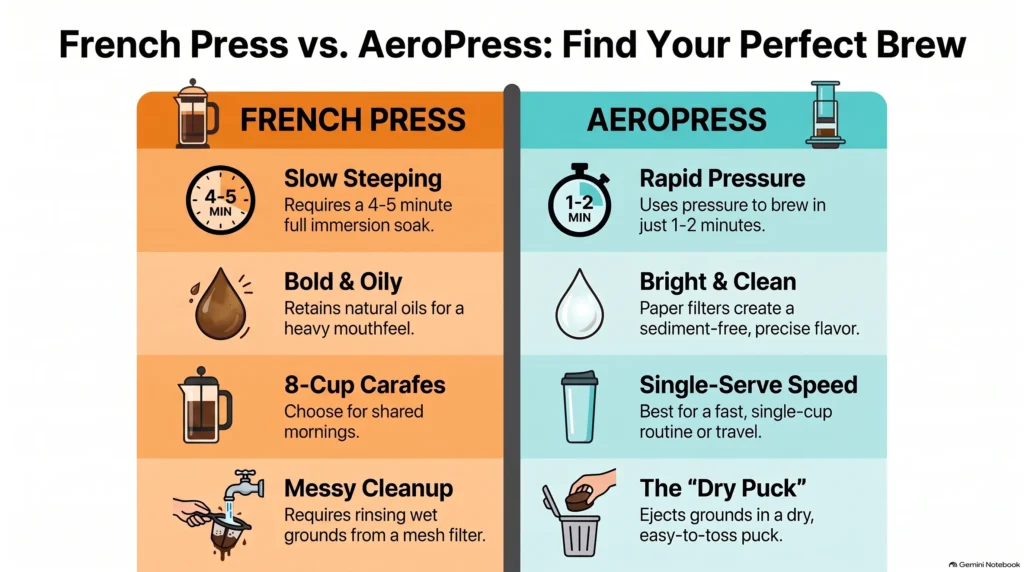
| Method | French Press | AeroPress |
|---|---|---|
| Brew method | Full immersion, steeped | Steeped briefly, then pressed through a filter |
| Brew time | 4 to 5 minutes | 1 to 2 minutes |
| Grind size | Coarse | Medium to fine |
| Coffee to water ratio | About 1:15 (roughly 23g coffee per 350ml water) | 1:15 for a full cup, or 1:6 to 1:8 as a concentrate diluted afterward |
| Body | Heavy, full, some sediment | Clean, smooth, low sediment |
| Cleanup | Wet grounds and a mesh filter to rinse | Grounds eject in a dry puck, quick rinse |
| Portability | Bulkier, often glass | Compact, lightweight plastic |
| Servings per brew | 4 to 8 cups | 1 to 2 cups |
| Best for | Slow mornings, bold coffee, small households needing multiple cups | Travel, speed, one or two precise cups |
Understanding the differences in the french press vs aeropress can enhance your coffee experience significantly.
How Each One Actually Works
The two brewers solve the same problem, getting water and ground coffee to interact long enough to extract flavor, in almost opposite ways.
French Press: Full Immersion
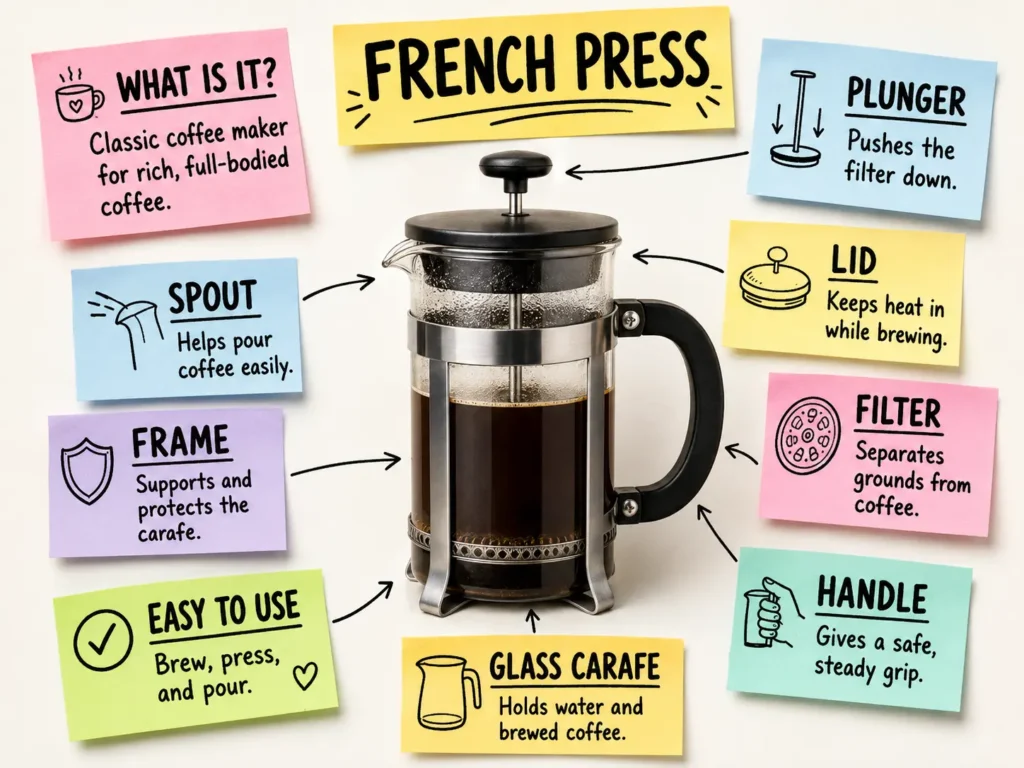
A French press submerges coarse coffee grounds directly in hot water for several minutes. There is no filter paper involved, only a metal mesh plunger that separates the liquid from the grounds at the end.
Because the grounds sit in contact with the water the entire time, more of the coffee’s natural oils and fine particles make it into the cup. That is what gives French press coffee its heavier, fuller body.
The French press design traces back to a 1929 Italian patent, though the version most people recognize today, with the metal plunger and mesh filter, was refined and popularized by companies like Bodum starting in the 1950s. It has stayed essentially unchanged for decades because the mechanism is simple and there is not much left to improve on.
AeroPress: Pressure and Speed
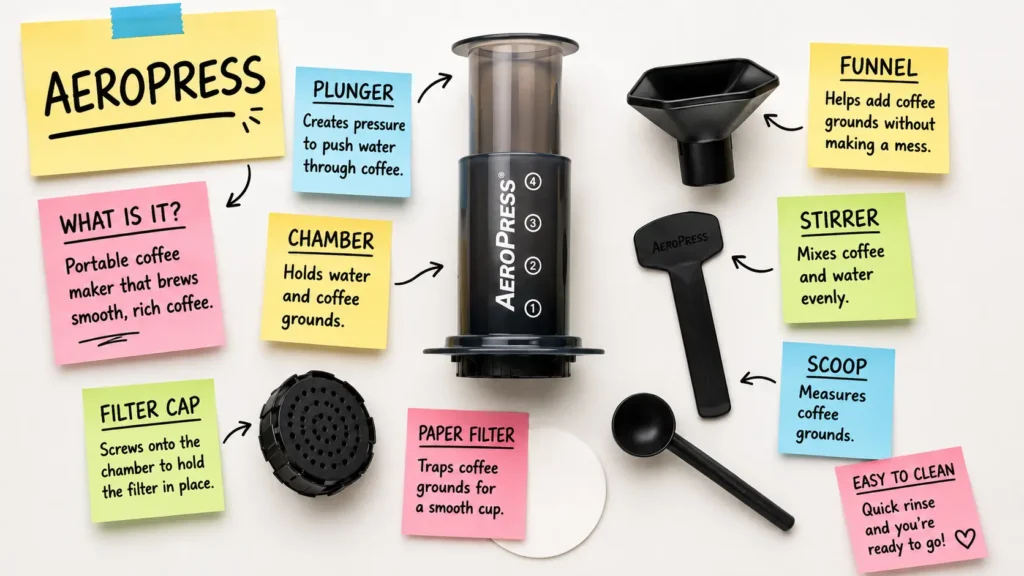
An AeroPress works more like a syringe. Coffee steeps briefly inside a plastic chamber, then you press the plunger down, forcing the coffee through a paper (or metal) filter in about 20 to 30 seconds.
The combination of a short steep time, a finer grind, and light pressure produces a cup that extracts quickly and cleanly. The paper filter also catches the oils and sediment that a French press lets through, which is the main reason AeroPress coffee tastes noticeably smoother.
The AeroPress is a much newer invention. Retired Stanford engineering lecturer Alan Adler began prototyping it in his garage in 2004, specifically because he was unsatisfied with the acidity and bitterness he was getting from espresso machines, pour-over, and French press alike.
He wanted a method that gave him direct control over brew time, water temperature, and grind size. It launched commercially in November 2005 and has since become a staple in specialty coffee shops and home kitchens, as well as a fixture on the competitive coffee circuit, where the World AeroPress Championship draws entrants from dozens of countries every year.
Flavor and Body: What Ends Up in Your Cup
This is where the two methods genuinely diverge. French press coffee tends to taste fuller and heavier, with a noticeable weight on the tongue and sometimes a light grit from fine particles that slip past the mesh filter.
It leans toward deeper, more chocolatey and nutty notes because those oils carry a lot of flavor with them, which is one reason certain whole bean choices suit a French press especially well.
AeroPress coffee, filtered through paper, comes out lighter and cleaner. Acidity and individual flavor notes tend to come through more clearly, which is part of why AeroPress has become popular with people who enjoy lighter roast levels and single-origin beans where subtle flavor differences actually matter.
Neither profile is more “correct.” It comes down to whether you want a cup that feels rich and full, or one that feels bright and precise.
Coffee to Water Ratio and Grind Size
Getting the ratio right matters more than most people assume, since it is the single biggest factor separating a weak, watery cup from a well balanced one.
French Press
The commonly recommended starting point is a 1:15 ratio, one gram of coffee for every 15 grams of water. For a standard 12 ounce (350ml) French press, that works out to about 23 grams, or roughly 3.5 tablespoons, of coarsely ground coffee. From there, most people adjust within a 1:12 to 1:17 range depending on how strong they like it.
The grind itself should look like coarse breadcrumbs or raw sugar, so it helps to know how to grind coffee for a French press correctly. Anything finer will slip past the mesh filter and leave sediment at the bottom of your cup. Some brewers also add a short double bloom step before the full steep to pull out even more flavor.
AeroPress
AeroPress is more flexible because the brewing chamber is small and the process is fast. A straightforward full cup follows roughly the same 1:15 ratio as French press.
Many AeroPress users instead brew a concentrate, using a stronger 1:6 to 1:8 ratio, then dilute it with hot water afterward to whatever strength they want, similar to an Americano.
The grind should be medium to fine, closer to table salt, since the shorter contact time needs a finer grind to extract enough flavor. If you are new to dialing in grind, our overview of coffee grind types is a useful starting point.
Brew Time in Practice
French press needs a full 4 to 5 minute steep before you press down. Rushing it under-extracts the coffee and leaves it tasting thin and sour.
AeroPress moves fast. From boiling the water to pressing the plunger, the entire process usually takes 1 to 2 minutes. If you are brewing on a tight schedule before work, that time difference adds up over a week.
Cleanup and Daily Practicality
French press cleanup means scooping out wet, used grounds and periodically pulling apart the plunger to rinse the mesh screen, which can trap fine particles over time. A quick look at the easiest ways to clean a French press makes this part of the routine faster.
AeroPress ejects spent grounds as a compact, mostly dry puck that pops out with a light push, plus a paper filter you toss and replace. A rinse under the tap is usually all it needs. For anyone brewing coffee before work on a weekday, this is a real difference.
Portability and Durability
French presses are typically glass carafes in a metal frame, which means they are more fragile and less travel friendly, though double-walled stainless steel versions exist if durability matters more to you than seeing the brew develop. If you still want to bring a French press along, there are options built for camping too.
AeroPress is made of lightweight, BPA-free plastic and weighs only about 6.5 ounces. It packs flat, survives a bag getting tossed around, and there is a dedicated travel version, the AeroPress Go, built for exactly this. If coffee needs to come with you, whether that is camping, a hotel room, or a desk at work, AeroPress is the more practical choice.
Cost and Ongoing Expenses
Both brewers are inexpensive relative to most home coffee equipment. A basic French press generally costs less upfront, though prices climb with glass thickness and stainless steel construction.
An AeroPress sits in a similar starting price range, with the ongoing cost of paper filters being the only real recurring expense. A pack of filters is cheap and typically lasts months of daily brewing, and reusable metal filters are available if you would rather skip that cost entirely.
Maintenance and Lifespan
A French press has more parts that can wear out. The mesh filter can loosen or clog over time, and glass carafes are the most common point of failure if dropped. With basic care, and the occasional deep clean of a stainless steel French press, a well made one can last many years.
An AeroPress has fewer failure points. The main wear item is the rubber seal on the plunger, which slowly loses its grip after heavy use and needs replacing every year or two of daily brewing. Replacement seals are inexpensive and take seconds to swap in. Barring that, the plastic body itself tends to outlast most other coffee gear in the kitchen.
Environmental Considerations
French press produces no filter waste at all, since the mesh is reusable indefinitely. The tradeoff is that unfiltered coffee lets through more of the oils that carry flavor, which some people prefer to filter out for reasons unrelated to taste.
AeroPress’s standard paper filters are single use, though they are thin, compact, and generate far less waste than a drip coffee maker’s filter.
Switching to a reusable metal filter removes that waste entirely, at the cost of a slightly heavier body closer to what you would get from a French press. If cutting down on kitchen waste matters to you generally, see our zero waste coffee ideas.
Common Mistakes to Avoid
- Grinding too fine for a French press. This is the most common reason people end up with gritty, sediment heavy coffee. Stick to a coarse, breadcrumb-like grind, and check our French press troubleshooting guide if it keeps happening.
- Rushing the AeroPress steep. Pressing the plunger down too early under-extracts the coffee. Give it at least 30 seconds of contact time before pressing, even in the standard fast method.
- Using water that is too hot. Water just off a rolling boil, ideally around 195 to 205°F per Specialty Coffee Association brewing standards, works best for both methods. Water that is too hot can scorch the grounds and pull out excess bitterness.
- Letting French press coffee sit in the carafe. Once it is done steeping, the coffee keeps extracting even after you plunge unless you pour it into a separate cup or thermos right away. Leaving it in the press is a common reason French press coffee turns bitter within minutes.
Who Should Choose Which
Choose a French press if you want a full-bodied cup, you are brewing for more than one person at a time, and you do not mind a slightly longer, more hands-on process. It helps to go in aware of the real tradeoffs of French press coffee too, so the extra effort does not catch you off guard.
Choose an AeroPress if you want a clean, smooth cup, you are short on time, you travel often, or you like fine-tuning variables like grind size and steep time to dial in a precise flavor.
Some coffee drinkers end up keeping both, and a few branch out further into percolators as a third option. A French press for a slow weekend pot shared with someone else, and an AeroPress for a fast, single cup on a weekday morning.
Frequently Asked Questions
Does AeroPress make stronger coffee than French press?
Strength depends more on your coffee to water ratio than the brewing method itself. AeroPress is often brewed as a concentrate and diluted, which can taste stronger, but knowing how to make strong coffee in a French press with a higher ratio gets you just as far.
Can I use the same beans for both?
Yes. The same beans will simply taste different depending on the method. Many people prefer a medium to dark roast in a French press for body, and a lighter roast in an AeroPress to highlight brighter, more distinct flavor notes. This applies even if you brew decaf coffee in a French press.
Which one is easier for a beginner?
AeroPress tends to be more forgiving. It is more tolerant of small variations in grind size or water temperature, so it is easier to get a consistently good cup while you are still learning. New French press users tend to have the same handful of beginner questions about French press coffee.
Do I need paper filters for AeroPress?
The standard AeroPress uses paper filters, though reusable metal filters are available if you want to skip the recurring cost and get a slightly heavier body closer to a French press.
Is one healthier than the other?
The main difference is that unfiltered French press coffee lets through more cholesterol-raising diterpene compounds, which paper filtering in an AeroPress mostly removes. This affects the coffee’s oil content, not its caffeine level, and either method fits comfortably into a normal coffee routine for most healthy adults.
Which one makes coffee faster for a busy morning?
AeroPress, by a wide margin. Its 1 to 2 minute brew time versus French press’s 4 to 5 minute steep is one of the clearest practical differences between the two.
The Bottom Line
French press and AeroPress are not competing for the same job. One is built for a slow, full-bodied pot you sit down with.
The other is built for a fast, clean cup you can make almost anywhere. Knowing which one you actually want on a Tuesday morning is the real answer to which is right for you. Once you have picked a side, our French press coffee recipes are a good place to go next.