French Press Coffee Accessories: Filters, Grinders and Tools Every Home Café Needs

Only 18% of home coffee drinkers own a dedicated burr grinder, yet grind quality is the single variable that separates a flat, muddy cup from a rich, full-bodied French press brew.
If the goal is a genuine home café experience, the French press is just the starting point. The full set of French press coffee accessories spans grinders, kettles, scales, replacement filters, and maintenance tools, each playing a measurable role in what ends up in the cup.
This guide covers every essential and worthwhile accessory, with clear recommendations, current benchmarks, and practical guidance for building a setup that works at any budget.
Key Takeaways
- A quality burr grinder is the single most impactful accessory for French press brewing, blade grinders produce uneven particles that ruin extraction.
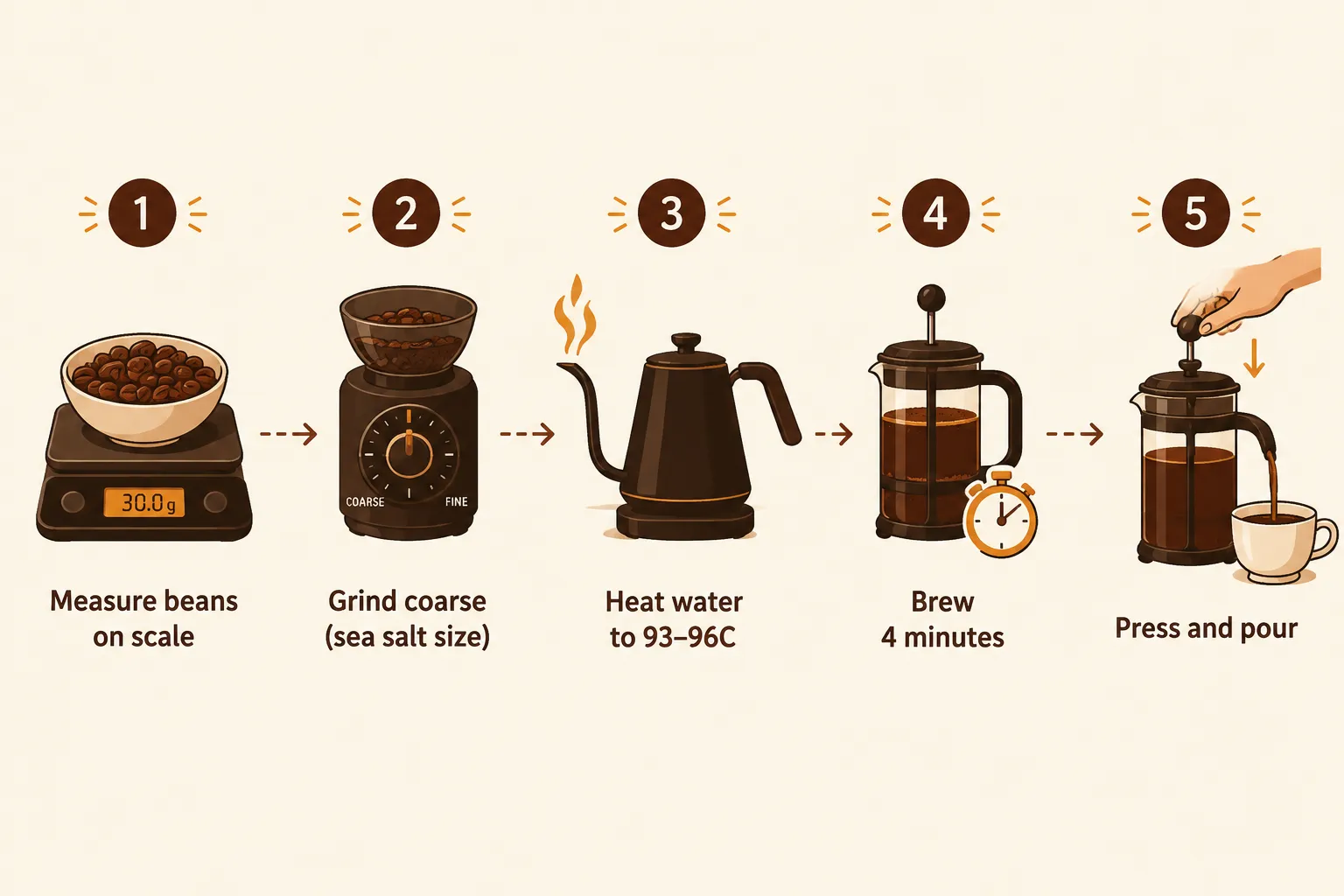
- Coarse grind consistency, equivalent to coarse sea salt, is the standard target for French press; precise dial settings (around 28-32 clicks on popular grinders) make this repeatable.
- Replacement mesh filters, gooseneck kettles, digital scales, and stirring tools complete a capable home café setup beyond just the press itself.
- Budgeting roughly 40-50% of total setup cost on the grinder delivers the best overall improvement in cup quality.
- Maintenance tools, cleaning brushes, descaling solutions, and extra filters, protect long-term performance and are often overlooked until something goes wrong.
Why the Grinder Is the Foundation of Every French Press Setup
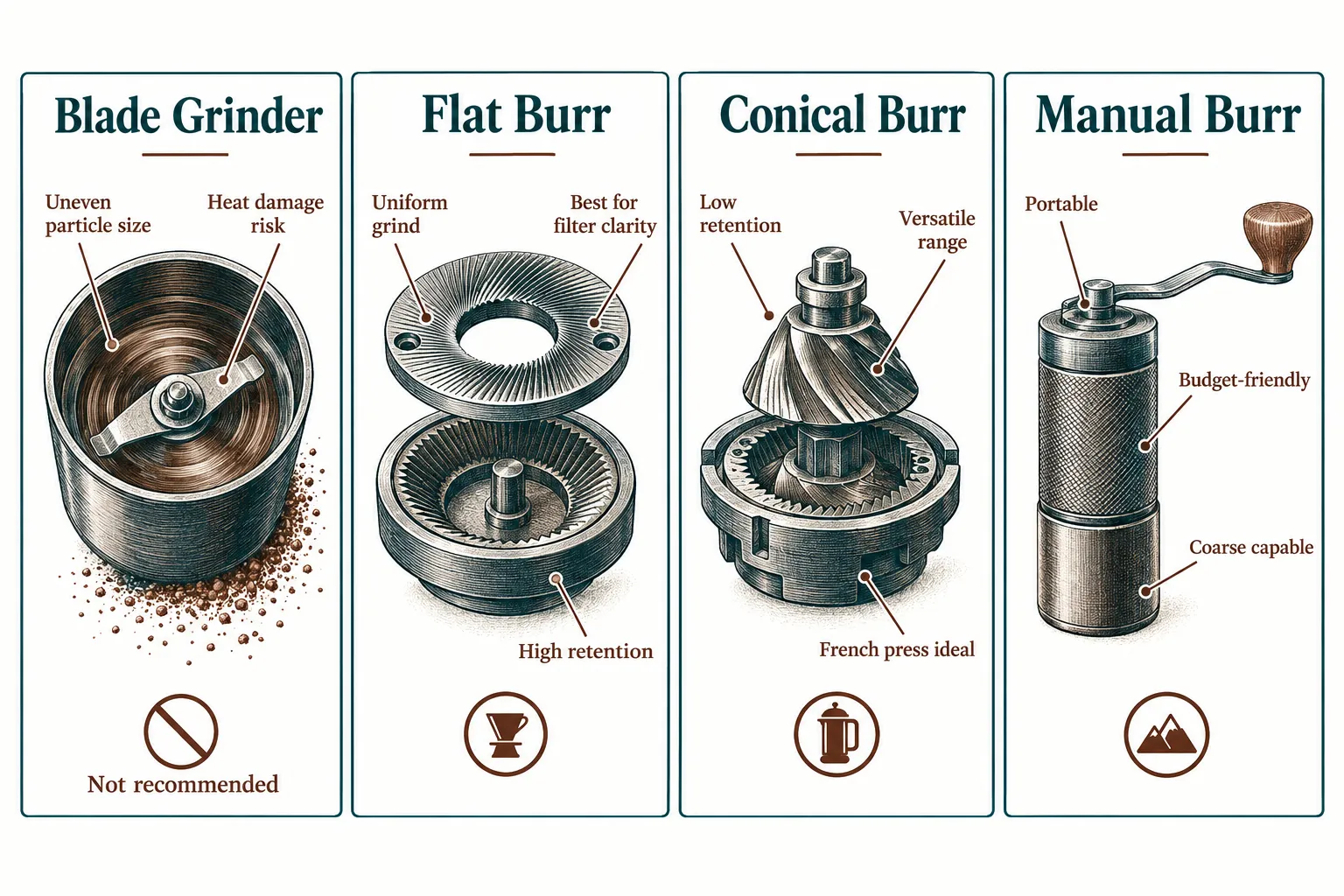
The most consequential decision in assembling your French press coffee accessories is choosing the right grinder. Expert consensus in 2026 is unambiguous: “always burr, never blade.” Blade grinders chop beans randomly, producing a mix of fine dust and large chunks. In a French press, where grounds steep directly in water, that inconsistency causes simultaneous over-extraction of fines and under-extraction of coarse pieces, resulting in a bitter, muddy cup.
Burr grinders, by contrast, crush beans between two abrasive surfaces set at a precise distance, producing particles of uniform size. For French press, the target is a coarse grind roughly equivalent to coarse sea salt.
On widely recommended home grinders, that translates to specific dial positions: approximately 28-32 clicks on the Baratza Encore, or 3.5-4.5 rotations on popular manual options like the 1Zpresso JX and KINGrinder K6.
If the French press coffee tastes bitter or gritty, the grind is almost always the cause. The 10 Reasons Why Your French Press Coffee Is Too Bitter guide explores this in detail, but the short answer is that finer-than-coarse grinds over-extract during the long steep time.
Electric Burr Grinders: Top Picks for Home Use
The Baratza Encore and its upgraded sibling, the Encore ESP, have become the default recommendations for home French press brewing in 2026. The original Encore is widely cited as the best burr grinder for most home brewers covering drip, pour-over, and French press.
The Encore ESP adds espresso capability while maintaining the same reliable coarse-grind performance, and with occasional burr swaps it can realistically last a decade, making it a genuinely cost-effective long-term investment.
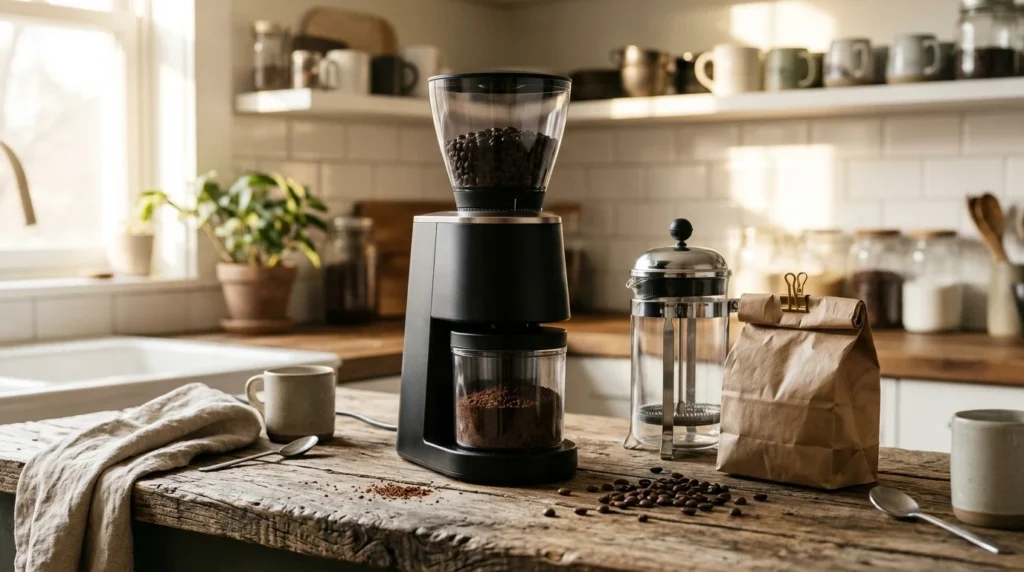
The Fellow Opus is another strong contender, noted for very low grind retention (approximately 0.8 g per session), which matters for users who weigh each dose precisely. The Eureka range offers even lower retention at around 0.2 g, appealing to enthusiasts who single-dose and want zero waste between brews.
Budget guidance for grinders:
| Tier | Typical Range | What to Expect |
|---|---|---|
| Entry-level | Under $60 | Noticeable inconsistency; acceptable for casual use |
| Mid-range home | $100 to $200 | Reliable coarse grind; suits most French press drinkers |
| Enthusiast | $200 to $300+ | Low retention, wide grind range, espresso-capable |
Grind consistency drops sharply below roughly $60, making that a practical floor for anyone serious about cup quality. Allocating 40-50% of the total coffee setup budget to the grinder is a widely repeated framework in 2026 guides.
For a deeper look at grind variables, the guide on How To Grind Coffee Beans: 5 Essential Considerations covers particle size, freshness, and technique in practical terms. For the exact French press texture, see How to Grind Coffee for a French Press.
Manual Burr Grinders: Portable and Budget-Friendly
Manual burr grinders offer genuine coarse-grind capability at a fraction of the cost of electric models. The 1Zpresso JX and KINGrinder K6 are frequently cited alongside electric options in 2026 grinder comparisons.
They suit travelers, campers, and anyone with limited counter space, and they pair well with the best French press for camping. The trade-off is time and physical effort, particularly for larger batches.
Essential Filters, Kettles, Scales and Stirring Tools
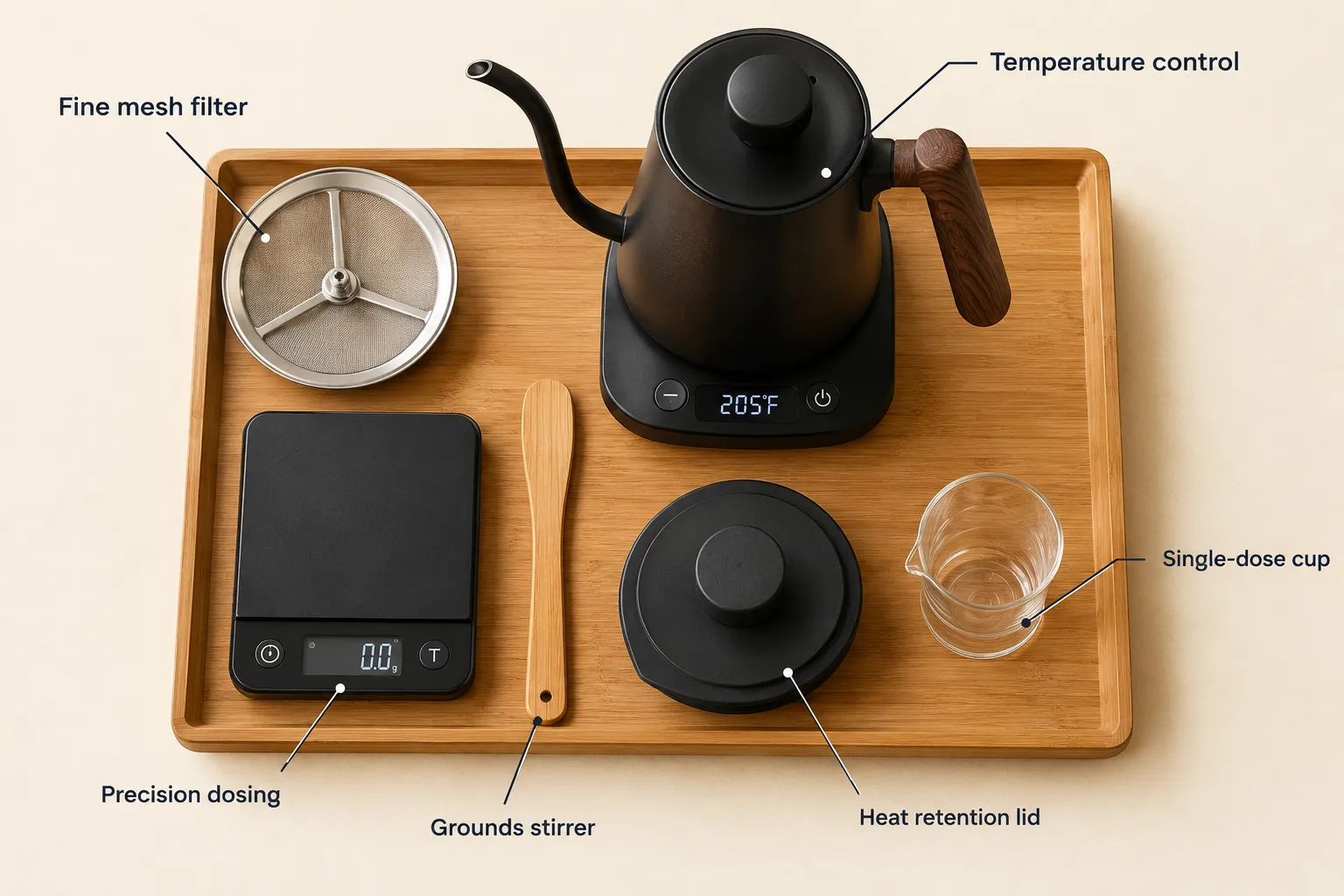
Beyond the grinder, a well-equipped home café needs several supporting accessories.
The French press itself handles the brewing, but the tools around it determine how consistently and comfortably that brewing happens. Accessory roundups in 2026 increasingly frame these items as a complete “coffee bar” setup rather than isolated purchases.
Replacement and Upgrade Filters
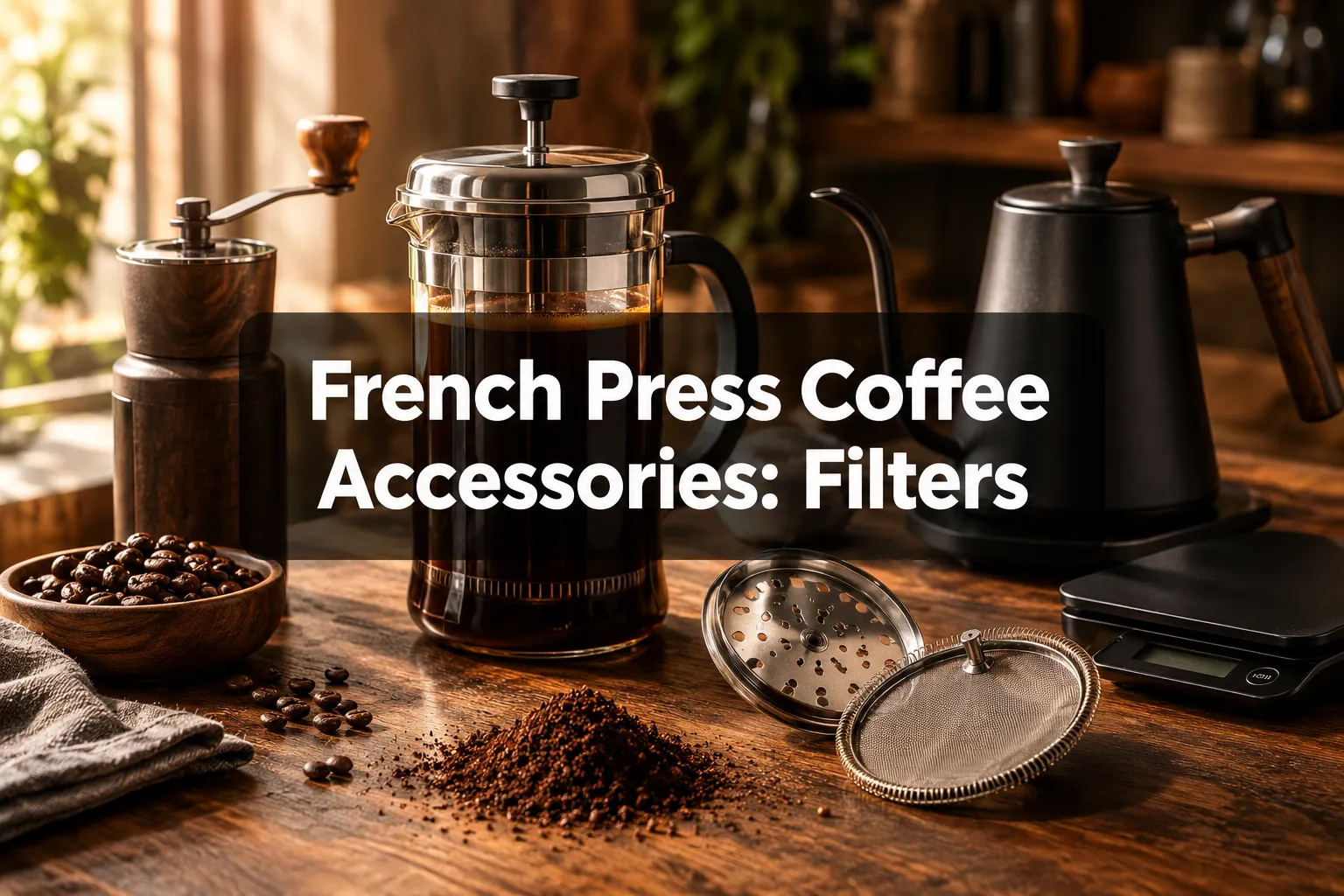
The standard stainless steel mesh filter that ships with most French presses allows fine sediment to pass through, a characteristic some drinkers enjoy and others find unpleasant. Several accessory options address this:
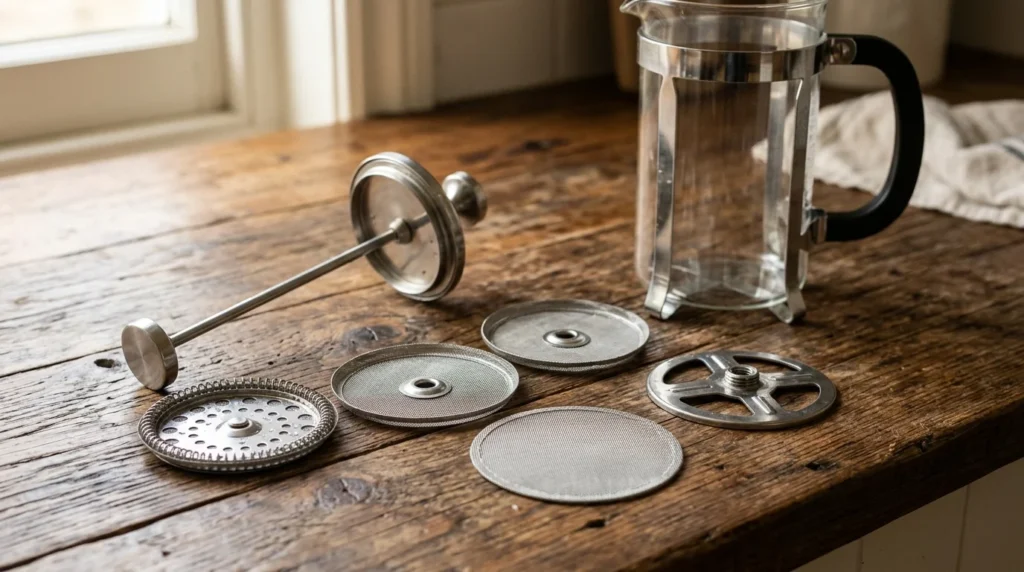
- Replacement mesh filters: Standard stainless steel screens wear out and warp over time. Keeping a spare prevents a failed press from derailing the morning routine.
- Extra-fine infuser screens: A secondary fine-mesh layer sits above the standard filter and catches more sediment, producing a cleaner cup closer to paper-filtered coffee without sacrificing the body that makes French press distinctive.
- Paper micro-filters: Circular paper inserts placed on top of the grounds before pressing catch ultrafine particles and oils.
- They are a useful option for drinkers who want lower cholesterol-raising diterpenes (cafestol and kahweol) in their cup, one of the noted Disadvantages Of French Press Coffee compared to paper-filter methods.
Gooseneck Kettles
Water temperature and pour control have an outsized effect on extraction. A gooseneck kettle, electric or stovetop, delivers water at a precise, steady flow rate directly onto the grounds. For French press, the target water temperature is 93-96°C (199-205°F). Electric gooseneck kettles with built-in temperature control eliminate guesswork entirely and hold temperature during the bloom phase.
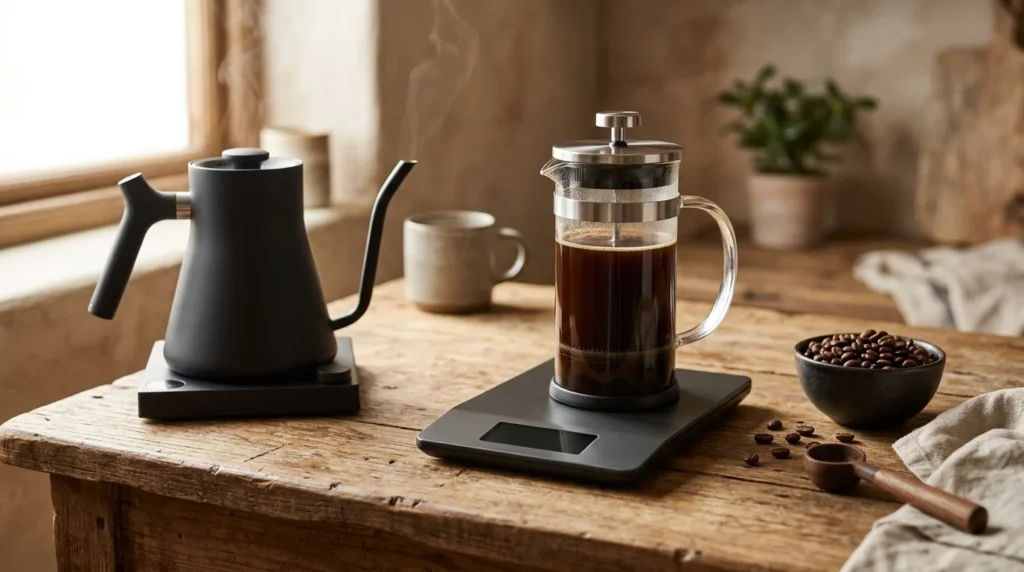
The Proctor Silex electric kettle is a frequently cited budget-friendly option in French press accessory guides. Variable-temperature models from Fellow, Bonavita, and Hario occupy the mid-range and are worth the premium for anyone who also brews pour-over.
Digital Kitchen Scales
Measuring coffee by volume (scoops) introduces significant inconsistency because bean density varies by roast level and origin. A digital kitchen scale that measures to 0.1 g precision standardizes the brew ratio.
The widely recommended starting point for French press is a 16:1 water-to-coffee ratio by weight, 16 grams of water for every 1 gram of coffee. The French press coffee water ratio guide has the numbers for every press size.
The CozyBlue digital coffee scale is a well-regarded option in the French press accessory category. Any scale with a tare function and 0.1 g resolution works well. For guidance on dialing in the ratio further, the article on How To Make Strong Coffee In A French Press? walks through adjustments step by step.
Stirring Tools and Covers
- Bamboo or stainless steel stirrers: Stirring grounds immediately after adding water ensures even saturation. The Frieling coffee stirrer is a dedicated option designed specifically for French press dimensions. Avoid metal spoons in glass carafes, they risk cracking the borosilicate glass.
- French press covers: A silicone or neoprene cover placed over the carafe during the 4-minute steep retains heat, particularly important in cool kitchens. The Zeal French press cover is a commonly recommended model.
- Borosilicate glass carafes: When replacing or upgrading the press itself, borosilicate glass is the preferred material because it resists thermal shock and does not impart any flavor to the brew. For a look at insulated alternatives, Double Walled French Press Coffee Makers reviews models that maintain temperature without a separate cover.
Building a Complete Home Café: Storage, Cleaning and Nice-to-Have Tools
Assembling a full set of French press coffee accessories means thinking beyond the brew itself. Storage, cleaning, and workflow accessories transform a collection of individual tools into a coherent, organized station.
Coffee Storage
Freshness degrades rapidly after roasting and even faster after grinding. Airtight, opaque canisters with one-way CO2 valves are the standard recommendation for whole beans.
Keeping beans at room temperature away from light and heat outperforms refrigeration for most home users. The detailed guide on 10 Best Practices: How To Store Coffee Beans And Grounds covers the full range of storage options and timelines.
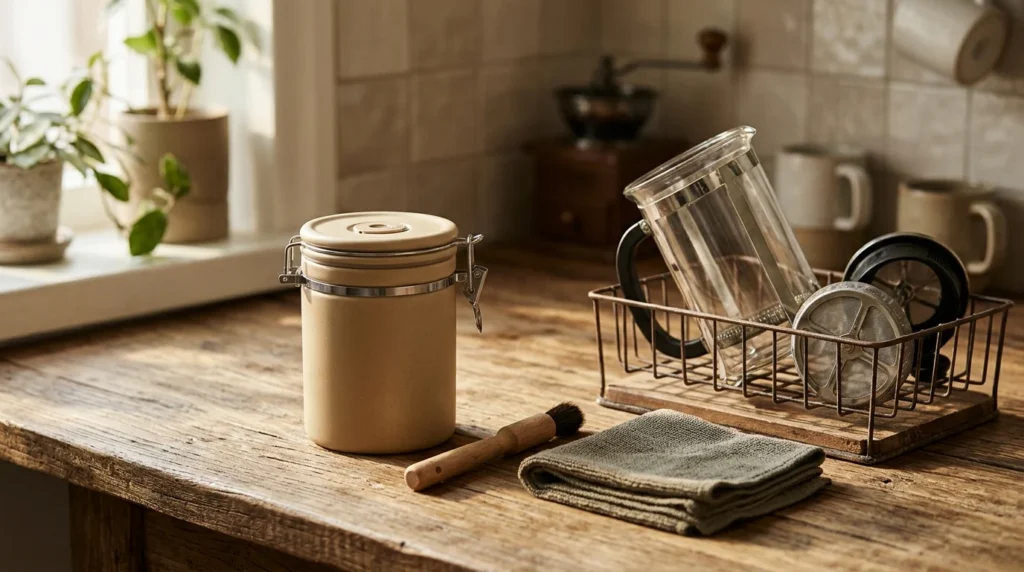
Cleaning Tools and Maintenance Accessories
French press maintenance is straightforward but easy to neglect. Oils from coffee grounds accumulate on the mesh filter and carafe walls, turning stale and contributing to bitter off-flavors over time. The guides on the best ways to clean a French press and how to deep clean a stainless steel French press walk through both routines.
Recommended cleaning accessories:
- Grinder cleaning brush: A stiff-bristle brush removes grounds from burr chambers between uses. Grinder cleaning tablets (such as Grindz) dissolve residue from burrs and are recommended monthly for daily-use grinders.
- Carafe cleaning brush: A long-handled bottle brush reaches the base of the carafe without scratching glass.
- Dish soap and hot water: Sufficient for daily cleaning of the filter assembly. Disassemble the plunger fully and clean each component separately.
- Descaling solution: For electric kettles, a periodic descaling cycle prevents mineral buildup that affects heating efficiency and water taste.
For stubborn coffee stains on counters, mugs, or clothing, the practical guide on 7 Ways How To Get A Coffee Stain Out Of Everything covers a range of surfaces and solutions.
Single-Dose Accessories
Enthusiast workflows increasingly favor single-dosing, loading exactly the right amount of beans for one brew rather than filling a hopper. This approach maximizes freshness and reduces grinder retention waste. Supporting accessories include:
- Dosing cups: Small stainless steel or acrylic cups that hold a pre-weighed dose and funnel directly into the grinder.
- Single-dose bellows: A rubber bulb that attaches to the grinder chute and blows retained grounds out after each session. Useful for grinders with retention above 1 g.
- Bean cellars or small airtight jars: For storing pre-weighed doses of whole beans for the week.
Expanding the Home Café Beyond French Press
A well-stocked home café can do more than French press. Many of the accessories above, the grinder, scale, and kettle, translate directly to other brew methods. For cold brew enthusiasts, the French Press Cold Brew Recipe demonstrates how the same press handles overnight cold extraction with no additional equipment.
For those exploring other coffee recipes, 20 Café-Style French Press Coffee Recipes offers creative uses for the same setup. To put the whole kit to work, try brewing French press coffee like Starbucks.
“The direction of grinder and accessory reviews suggests future launches will pair coarse-grind capability with precise scales, timers, and kettles in unified home café bundles.”
This trend toward integrated setups reflects how seriously home brewers now treat the daily coffee ritual, not as a chore but as a considered practice worth investing in.
Conclusion
Building a capable French press home café does not require buying everything at once. The most impactful first step is replacing a blade grinder with a quality burr grinder, ideally the Baratza Encore or Encore ESP, and dialing in the coarse grind setting.
From there, adding a digital scale, a gooseneck kettle, and a replacement mesh filter covers the majority of quality improvements available without major expense.
Actionable next steps:
- Audit the current setup: identify whether a blade grinder is the limiting factor.
- Invest in a mid-range burr grinder ($100 to $200) before upgrading the French press itself.
- Add a digital scale and use the 16:1 water-to-coffee ratio as a starting point.
- Replace the mesh filter annually or whenever the plunger action feels loose.
- Establish a weekly cleaning routine for the grinder and carafe to protect flavor over time.
The accessories covered in this guide are not luxuries, they are the practical infrastructure that makes consistent, high-quality French press coffee repeatable every morning.