French Press Coffee Sour? Causes and Simple Fixes That Work

Sour coffee in a French press almost always means the brew is under-extracted: not enough of the sweet, balanced compounds made it out of the grounds before you plunged. This is a common issue that can lead to what many describe as French Press Coffee Sour.
The four usual culprits are an under extracted French press caused by a French press grind too coarse, French press water too cool, a steep time under four minutes, or too little coffee for the amount of water.
Fix it by grinding a little finer, brewing with water at 195-205°F (90-96°C), steeping 4-5 minutes, and using roughly 1 gram of coffee for every 15 grams of water. Change one variable at a time so you can tell what actually worked.
Key Takeaways
- Sour means under-extracted, not “too acidic beans.” Sourness comes from acids being released early in brewing while the sugars and balancing compounds are still locked in the grounds .
- A French press grind too coarse is the number one cause. Coarse chunks have less surface area, so water can’t pull enough flavor out in four minutes .
- French press water too cool slows extraction dramatically. Aim for 195-205°F. Boiling water poured into a cold glass carafe can drop 10-15°F instantly.
- Steeping under 4 minutes reliably produces sour cups. Most French press recipes land at 4-5 minutes total.
- Weak ratios taste sour and thin. Under about 1:17 coffee-to-water, many cups read as sharp and hollow.
- Sour and bitter are opposite problems. Sour = under-extracted (needs more). Bitter = over-extracted (needs less).
- Light roasts and very fresh beans need more help: finer grind, hotter water, or a longer steep.
- Grind consistency matters as much as grind size. Blade grinders create dust plus boulders, so you get bitter and sour flavors in the same cup.
- Change one variable per brew. Two changes at once and you’ll never learn your machine.
What Causes Sour Coffee in a French Press?
Sour coffee in a French press is caused by under-extraction, which means the water didn’t dissolve enough of the coffee’s flavor compounds before you pressed.
Coffee extracts in a rough order: acids come out first, then sugars and sweetness, then the heavier bitter compounds last . Stop the process early, or slow it down, and you’re left holding a cup of mostly acid.
I learned this the hard way on a camping trip. I’d brought pre-ground “French press” coffee, boiled water over a fire, waited what felt like long enough, and poured. It tasted like lemon water with a coffee smell.
The grounds were huge, the water had cooled while I fussed with the pot, and I’d plunged at about two and a half minutes. Three mistakes stacked on top of each other.
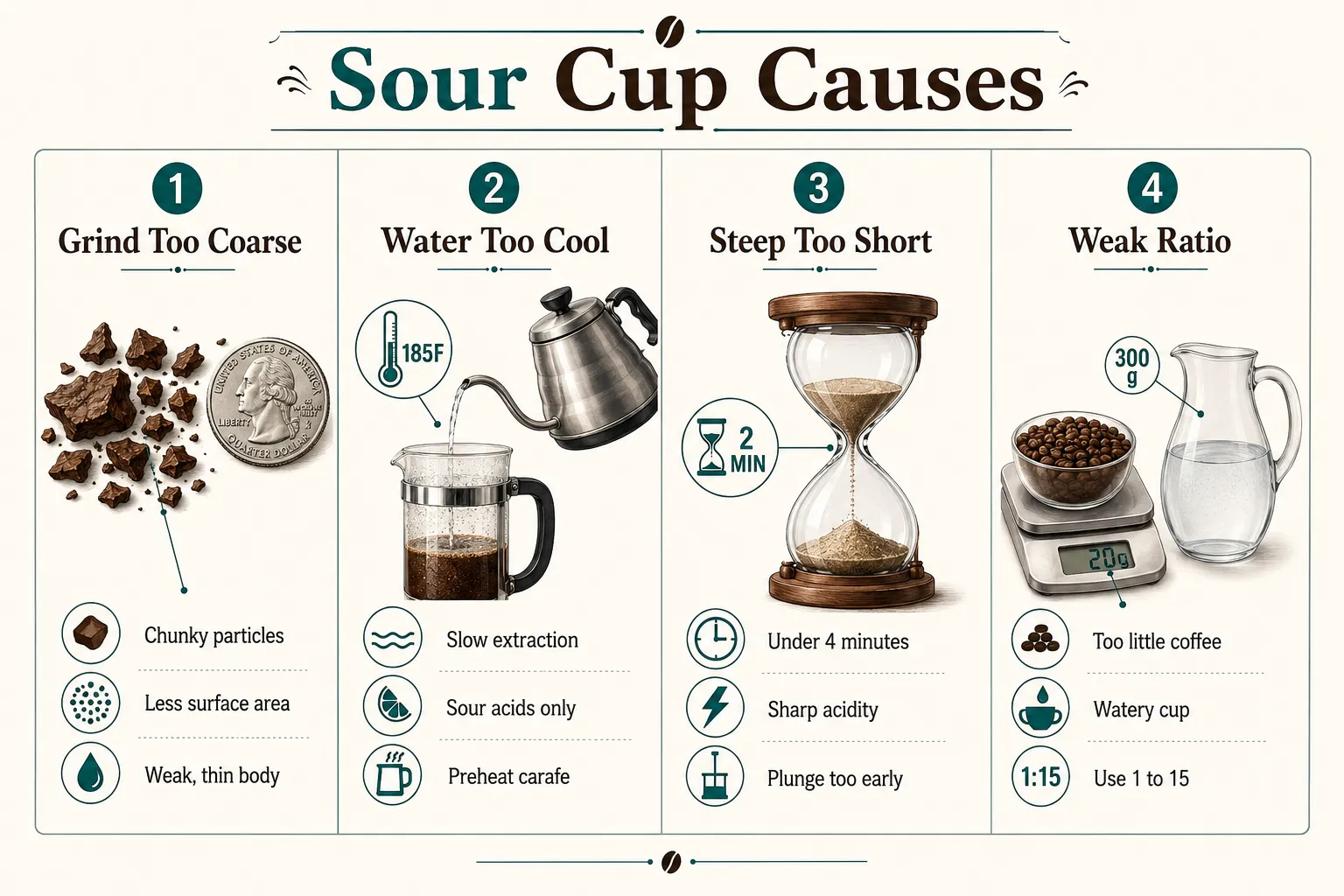
Here are the causes, ranked by how often they’re the real problem in home brewing:
| Cause | What it does | Quick fix |
|---|---|---|
| Grind too coarse | Not enough surface area for water to work on | Grind one or two steps finer |
| Water too cool | Slows the chemistry; acids release, sugars don’t | Use water at 195-205°F, preheat the carafe |
| Steep too short | Cuts extraction off mid-process | Extend to 4-5 minutes |
| Weak ratio | Too little coffee in too much water | Move toward 1:15 |
| Poor wetting / no stir | Dry pockets of grounds never extract | Bloom, then stir gently |
| Very light roast, very fresh beans | Denser, harder to extract; CO2 pushes water away | Finer grind, hotter water, longer steep |
| Stale or blade-ground coffee | Uneven particles extract unevenly | Fresh whole beans, burr grinder |
Decision rule: if the cup tastes sharp and thin and watery, it’s under-extraction. If it tastes sharp but heavy and syrupy, check your ratio first, you may have plenty of coffee but a grind that’s far too coarse.
Understanding French Press Coffee Sour
An under extracted French press cup has a specific signature: sour or sharply tart up front, thin in the mouth, a fast finish that disappears, and sometimes a papery or salty edge. If you swallow and there’s almost nothing left on your tongue two seconds later, extraction stopped too early.
Use this checklist while tasting:
- Sour, lemony, or sharp on the first sip, especially at the front of the tongue
- Thin, watery body, the coffee feels like tea, not coffee
- Salty or savory note in the middle (a classic under-extraction marker).
- Short finish with no lingering sweetness or chocolate
- Looks pale or reddish-brown rather than deep brown when you tilt the cup
- Grounds look barely wet or unevenly soaked when you dump the pot
Quick example: I once brewed the same Ethiopian beans twice, ten minutes apart. Brew one, coarse grind, 3-minute steep: tart, thin, gone by the time I set the cup down. Brew two, one step finer, 5-minute steep: blueberry, sugar, a finish that lasted. Same beans, same water. Only the extraction changed.
Common mistake: blaming the beans. A naturally bright Ethiopian coffee has real fruit acidity, which is pleasant and complex. Under-extraction is different: it’s flat, one-note sour with no sweetness behind it. Pleasant acidity has something underneath it. Sourness is hollow.
Sour Coffee French Press vs Bitter: What’s the Difference?
Sour and bitter are opposite ends of the same dial. Sour means you extracted too little, so push extraction up. Bitter means you extracted too much, so pull it back. Confusing the two is why people spend weeks making their coffee worse.
| Sour (under-extracted) | Bitter (over-extracted) | |
|---|---|---|
| Taste | Tart, lemony, sharp, salty | Harsh, ashy, dry, hollow-bitter |
| Body | Thin, watery | Heavy but rough, drying |
| Finish | Vanishes fast | Lingers unpleasantly |
| Grind fix | Finer | Coarser |
| Time fix | Longer steep | Shorter steep |
| Temp fix | Hotter water | Slightly cooler water |
| Ratio fix | More coffee | Less coffee |
The tricky part: a single cup can be both. Uneven grinds create fines that over-extract into bitterness while the boulders sit there under-extracted and sour. That’s the flavor most people describe as “harsh and sour at the same time,” and it’s a grinder problem, not a recipe problem .
If your coffee tastes sour AND bitter in the same sip, stop adjusting the recipe. Your grinder is producing dust and boulders, and no brew time can fix that.
If your problem runs the other direction, our guide to why French press coffee turns out too bitter covers the over-extraction side in detail.
Is My French Press Grind Too Coarse? Finding the Best Grind Size
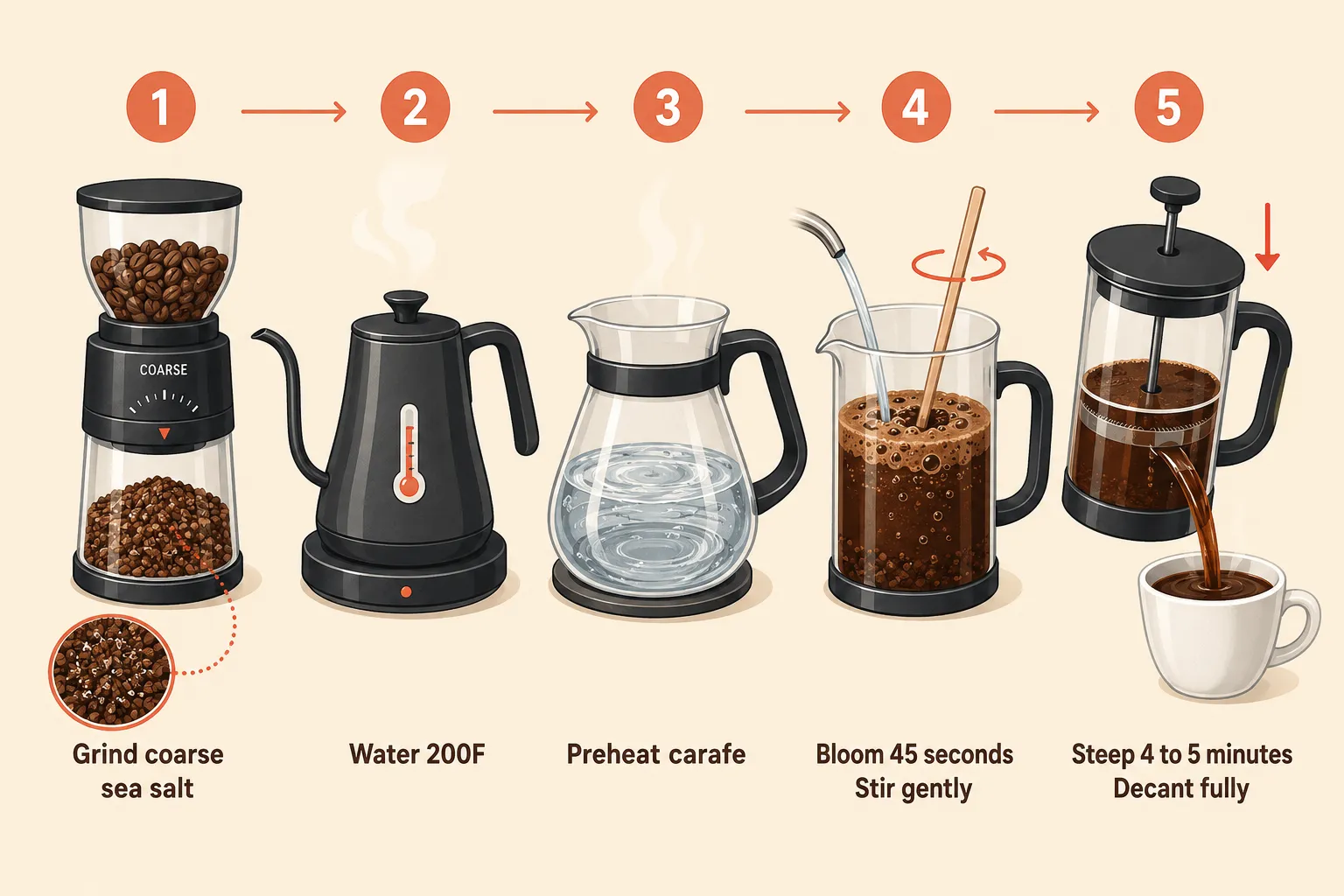
A French press grind too coarse is the most common cause of sour coffee, and yes, that’s true even though French press is famous for needing a coarse grind. The target is coarse sea salt or rough breadcrumbs, not peppercorns, not gravel. If your grounds look like cracked wheat, you’ve gone too far.
Here’s the visual reference I use:
- Too coarse (sour): distinct chunks you can pick up individually, like cracked pepper or panko crumbs
- Correct: coarse sea salt, slightly gritty between your fingers, grains roughly 0.7-1.0 mm
- Too fine (bitter, muddy, hard to plunge): sand or table salt; also clogs the mesh and leaves sludge
Most manufacturers ship French presses with instructions that just say “coarse,” and most people over-correct. The mesh filter forgives a slightly finer grind than you’d expect. If you’re getting a clean plunge with no resistance at all, you likely have room to go finer.
Practical dialing method: grind one notch finer, keep everything else identical, and taste. Repeat until sourness disappears. The moment you notice dryness or bitterness, back off half a notch. That’s your setting.
Grinder type matters more than the dial number:
- Burr grinder (hand or electric): consistent particle size, the single best upgrade for sour cups.
- Blade grinder: produces dust and boulders simultaneously; if this is your grinder, pulse in short bursts and shake the chamber between pulses.
- Pre-ground supermarket “French press” coffee: often ground too coarse and stale; expect to compensate with hotter water and a longer steep.
For a full walkthrough, see our guide on how to grind coffee for a French press, plus the broader breakdown of coffee grind types and what each brewer needs.
Edge case: if you brew a metal double-wall press, you can often go slightly finer than in glass because heat retention is better, which compensates for the extra surface area. Our roundup of double-walled French press coffee makers explains why insulation changes the equation.
What Water Temperature Should I Use for French Press?
Use water at 195-205°F (90-96°C). Below about 190°F, extraction slows enough that acids dominate and sweetness never develops, which is exactly how French press water too cool produces a sour cup .
Does water temperature affect French press extraction? Significantly. Hotter water dissolves coffee solids faster and more completely. Cooler water is selective in the worst way: it pulls the quick-releasing acids and leaves the sugars and body behind.
The hidden temperature thief in most kitchens isn’t the kettle. It’s everything after it:
- A cold glass carafe drops the brew temperature the instant you pour. Rinse the press with hot water first and dump it.
- Cold, room-temperature grounds absorb heat too.
- A thin glass beaker loses heat throughout the steep, especially in a cool kitchen.
- Waiting too long after boiling. Off-boil water sitting uncovered on the counter can lose 10-15°F in a couple of minutes.
No thermometer? Use this method: bring water to a full boil, take it off the heat, and wait 30-45 seconds. That lands you around 200°F in most kitchens. Then pour into a preheated press.
Decision rule: choose the hotter end of the range (200-205°F) for light roasts, dense high-altitude beans, and coarser grinds. Choose the cooler end (195-198°F) for dark roasts, which extract easily and turn bitter fast.
Common mistake: brewing at high altitude without adjusting. Water boils below 212°F as elevation rises, so your “boiling” water may only be 195°F or less at the start. At altitude, grind finer or steep longer to compensate.
How Long Should a French Press Steep? A Brewing Time Guide
Steep 4 to 5 minutes for a standard medium-roast, medium-coarse grind. Steeping under 4 minutes is one of the strongest predictors of a sour French press cup, because the sweetness-producing extraction is still in progress when you plunge .
Here’s a working French press brewing time guide:
| Situation | Steep time | Notes |
|---|---|---|
| Standard medium roast, coarse grind | 4:00-5:00 | The default starting point |
| Light roast or dense beans | 5:00-6:00 | Denser cell structure needs more contact time |
| Dark roast | 3:30-4:00 | Extracts fast; long steeps turn ashy |
| Grind on the coarser side | 5:00-6:00 | Time compensates for less surface area |
| Cold kitchen / thin glass press | 5:00-5:30 | Offsets heat loss during the steep |
| Cold brew in a French press | 12-18 hours | Different method entirely; see below |
My routine, timed: pour a third of the water over the grounds, let them bloom 45 seconds while the CO2 escapes, stir gently, add the rest of the water, cap it, wait until 4:30 total, plunge slowly, and pour everything out immediately.
That last step is the one most people skip. Coffee left sitting on the grounds after plunging keeps extracting and will drift bitter within minutes. Decant into a mug or a thermal carafe.
Can you over-extract French press coffee? Yes, easily. Past roughly 8-10 minutes with a proper grind, most brews turn harsh, dry and bitter. And because the press has no paper filter, the fines stay in contact with the liquid the whole time, so over-extraction develops faster than people expect. That’s one of the trade-offs we cover in the disadvantages of French press coffee.
Cold brew is the exception: at refrigerator temperature, the extraction rate is so slow that 12-18 hours is normal. If you want to try it, our French press cold brew recipe walks through the ratios.
My French Press Coffee Tastes Acidic: How Do I Fix It Step by Step?
To fix an under extracted French press, adjust in this order: ratio, then temperature, then grind, then time. Change one thing per brew and taste before moving on. Most sour cups resolve within three attempts.
Step-by-step fix checklist
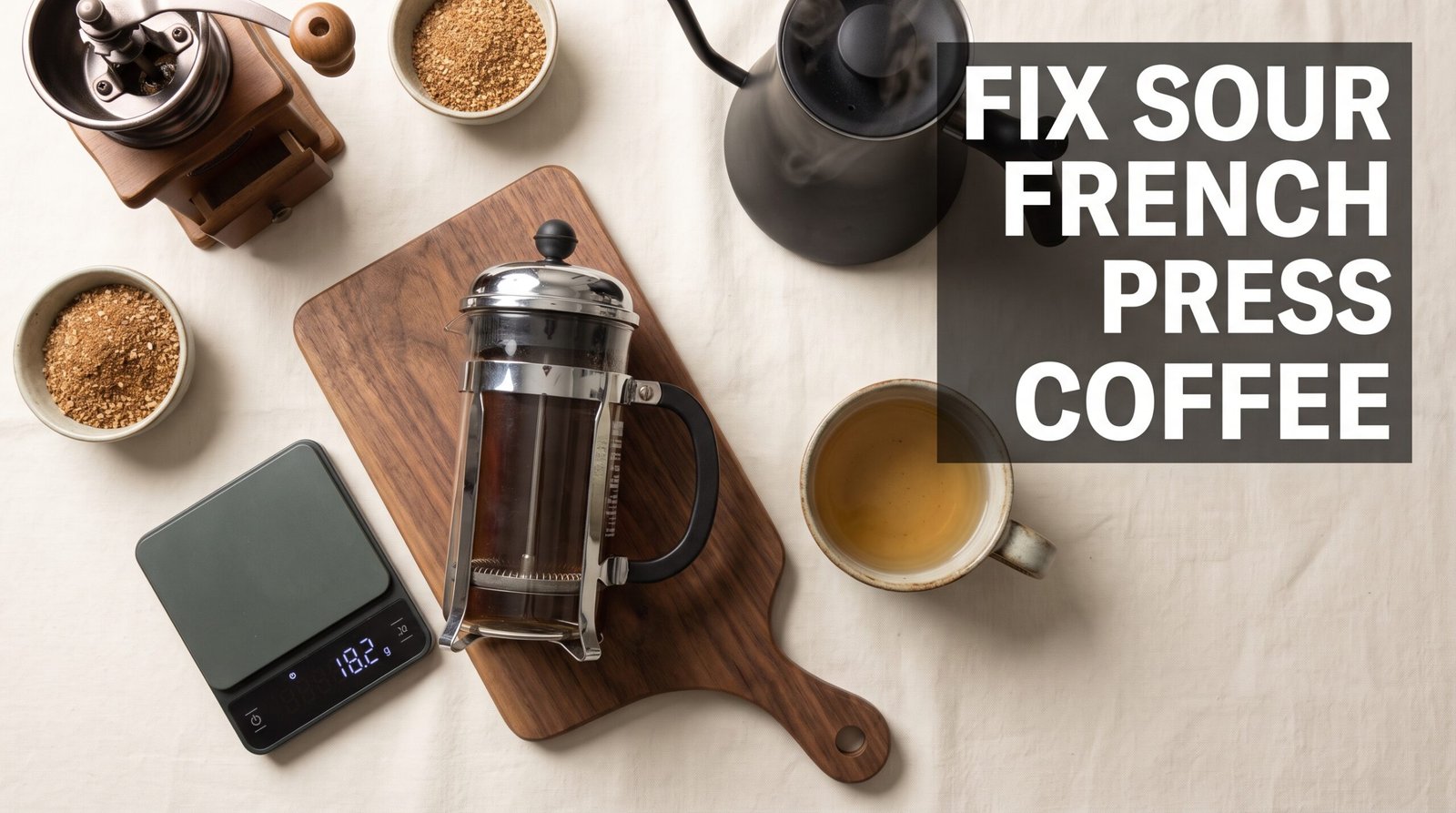
- Weigh your coffee and water. Start at 1:15, 30 g coffee to 450 g water (about 2 tablespoons per 8 oz cup, but a scale is far more reliable). Weak ratios taste sour and thin no matter what else you do. Our French press coffee-to-water ratio guide has the numbers for every press size, and how much coffee to use in a French press covers volume measuring if you don’t own a scale yet.
- Preheat the press. Fill with hot water, swirl 20 seconds, dump it.
- Get the water right. 200°F, or boil-then-wait-40-seconds.
- Grind one notch finer than whatever you used for the sour cup. Coarse sea salt is the target.
- Bloom properly. Add water to roughly double the coffee’s weight, wait 45 seconds, stir gently so every ground is wet. Dry clumps never extract and taste sour in the final blend. The French press double bloom technique is worth trying with very fresh beans.
- Add the rest of the water, lid on, plunger up. Start a timer.
- Steep 4:30. Stir once at the 1-minute mark if you like a fuller body.
- Plunge slowly, about 15-20 seconds of steady pressure. Fast plunging pushes fines through and stirs up sediment.
- Decant immediately into a cup or thermal carafe.
- Taste and note what you changed. If it’s still sour, go finer or add 30 seconds. If it’s now bitter or dry, you overshot; back off half a step.
The time-grind trade-off
Grind and time do overlapping work, so you don’t need to change both. Grinding finer raises extraction quickly and also changes body and clarity. Adding time raises extraction more gently. If you’re close to a good cup, add 30 seconds. If the cup is badly sour, change the grind, since time alone rarely rescues a genuinely coarse grind.
Rule of thumb: one notch finer on a hand grinder ≈ 30-60 seconds of extra steep time in flavor impact.
What Are the Most Common French Press Mistakes Behind Sour Coffee?
The most common French press mistakes that cause sourness are guessing at measurements, plunging early, using cold equipment, and brewing with stale or blade-ground coffee. Each one alone can sour a cup, and they tend to travel in packs [4].
- Eyeballing the coffee. Scoops vary hugely by grind size and bean density. A scale ends the guessing.
- Plunging as soon as it “looks ready.” Color develops long before flavor does.
- Skipping the preheat. Glass steals heat immediately.
- Never stirring. The dry crust on top holds grounds that contribute nothing but sour under-extracted liquid.
- Using pre-ground coffee that’s weeks old. Stale coffee tastes flat and papery, which people often read as “sour.” Fresh whole beans for French press fix more problems than any brewing tweak.
- Brewing beans roasted two days ago. Very fresh coffee is loaded with CO2, which pushes water away from the grounds and blocks even extraction. Rest most beans 5-14 days after roast.
- A dirty press. Old coffee oils in the mesh and threads go rancid and add a sharp, sour-off note. Deep clean it regularly, our best ways to clean a French press guide covers the disassembly.
- Bad water. Distilled or heavily softened water extracts poorly and can taste flat and sour. Filtered tap water with normal mineral content works best.
- Storing beans in the freezer door or a clear jar on the counter. Follow proper coffee bean storage practices instead.
Edge case worth knowing: some light-roast, high-acidity coffees, particularly washed Kenyans and Ethiopians, taste tart to palates used to dark roast even when extraction is perfect.
If you’ve dialed everything in and it still reads too bright, the coffee may simply not match your taste. Try a medium roast or a natural-process bean before you keep chasing the recipe.
French Press Troubleshooting Guide: Quick Reference
Use the symptom-to-fix table below as a fast diagnostic. For each symptom, apply the first fix, brew again, then reassess.
| Symptom | Likely cause | First fix | If that fails |
|---|---|---|---|
| Sour, thin, short finish | Under-extraction | Grind finer one notch | Extend steep to 5:00 |
| Sour and weak | Ratio too low | Move to 1:15 | Raise water temp to 200°F |
| Sour in a cold kitchen | Heat loss | Preheat the press | Switch to insulated press |
| Sour with fresh light roast | CO2 blocking water | Bloom 45 s and stir | Rest beans 7-10 days |
| Sour and bitter together | Uneven grind | Use a burr grinder | Sift out fines |
| Bitter and dry | Over-extraction | Grind coarser | Cut steep to 3:30 |
| Muddy, hard to plunge | Grind too fine | Grind coarser | Plunge more slowly |
| Flat, papery, dull | Stale coffee | Buy fresh whole beans | Grind right before brewing |
| Sharp off-taste, oily film | Dirty press | Deep clean filter and threads | Replace mesh screen |
If your issue isn’t sourness specifically, our broader French press coffee troubleshooting guide and the top beginner questions about French press coffee cover sediment, plunger resistance, temperature drop and more.
FAQ
Why does my French press coffee taste sour but my drip coffee doesn’t? Drip machines typically use a finer grind and force water through the bed continuously, which extracts more efficiently. French press relies on full immersion, so if the grind is too coarse or the steep too short, extraction falls short and sourness shows up.
Is sour coffee under-extracted or over-extracted? Sour coffee is under-extracted. Acids release early in brewing, while the sugars and balancing compounds come out later. Bitter coffee is the over-extracted opposite [10].
What is the best grind size for a French press? Coarse sea salt or rough breadcrumbs, roughly 0.7-1.0 mm. Chunky, gravel-like grounds are too coarse and produce sour, thin coffee.
What temperature should French press water be? 195-205°F (90-96°C). If you don’t have a thermometer, boil the water then wait 30-45 seconds before pouring into a preheated press.
How long should French press coffee steep? 4 to 5 minutes for a medium roast at a coarse grind. Light roasts often need 5-6 minutes; dark roasts do better at 3:30-4:00.
Can you over-extract French press coffee? Yes. Past about 8-10 minutes at a proper grind, most brews turn bitter and dry. Always decant immediately after plunging, because coffee left on the grounds keeps extracting.
Does adding more coffee fix sour coffee? Sometimes. If your ratio was weaker than about 1:17, adding coffee helps. But if the grind is too coarse or the water too cool, more coffee just gives you more under-extracted coffee.
Why is my light roast French press coffee always sour? Light roasts are denser and harder to extract. Grind finer, use water at 200-205°F, and steep 5-6 minutes. Also rest very fresh beans 7-14 days after roast so trapped CO2 stops blocking the water.
Does stirring the French press reduce sourness? Yes, usually. Stirring after the bloom wets every ground and prevents dry pockets that contribute sour, under-extracted liquid to the final cup.
Can hard or filtered water make coffee taste sour? Yes. Distilled or heavily softened water lacks the minerals that carry extraction, which can leave coffee flat and sour. Filtered tap water with normal mineral content is the safest choice.
Should I fix grind size or brew time first? Fix the ratio first, then temperature, then grind, then time. Grind changes have the biggest effect on extraction, so use them for badly sour cups and use time for small final adjustments.
Does a dirty French press cause sour coffee? It can. Rancid coffee oils trapped in the mesh filter and lid threads add a sharp, sour-off flavor that no recipe change will remove. Deep clean the filter assembly weekly.
Conclusion
Sour French press coffee is a solvable extraction problem, not bad luck and not usually bad beans. In nearly every case, the cup is under-extracted because the grind is too coarse, the water is too cool, the steep is too short, or the ratio is too weak, often several at once.
Your next three brews, in order:
- Brew one: weigh 30 g coffee to 450 g water, preheat the press, use water at 200°F, steep 4:30, decant immediately. Note the taste.
- Brew two: if still sour, grind one notch finer. Change nothing else.
- Brew three: if still sour, add 30 seconds to the steep. Then stop and enjoy it.
Keep a note on your phone with grind setting, dose, water temperature and time. Three brews of honest record-keeping will teach you more about your grinder than a year of guessing.
And when you’ve got a clean, sweet baseline cup, that’s the moment to start playing, try a few of the interesting French press coffee recipes or push the strength with our guide to making strong coffee in a French press.