Best Percolator for Office Use (2026): Sizes, Top Picks and Setup Guide

Quick Answer
The best percolator for office use depends on how many people drink coffee:
- 2 to 6 people: a 12-cup electric percolator in stainless steel.
- 8 to 15 people: a 30 to 45 cup percolating urn.
- 20 or more people: a 60 to 100 cup commercial percolator with ETL or NSF certification.
Whatever size you pick, get one with automatic keep-warm and a stainless steel body. Plan to drink the coffee within about two hours of brewing. After that it turns flat and bitter, so a smaller batch brewed twice beats one giant batch sitting all day.
One thing to know before you shop: many products called “coffee urns” are percolators, but not all of them. Some are drip machines or plain hot water dispensers. Every pick in this guide actually percolates.
Top Picks at a Glance
These four are all true percolators. Specs come from the maker or a commercial supplier listing.
| Model | Capacity (cups) | Body | Certification | Best for |
|---|---|---|---|---|
| Presto 02811 | 2 to 12 | Stainless steel | Not listed | 2 to 6 people |
| SYBO SR-CP-50B | Up to 50 (8 L) | 304 stainless steel | ETL | 8 to 20 people |
| SYBO SR-CP-100B | Up to 100 (16 L) | 304 stainless steel | ETL | 20+ people, events |
| West Bend 33600 | 40 to 100 | Polished aluminum | NSF, cULus | Budget commercial, inspected kitchens |
Percolator vs Coffee Urn: Are They the Same?
Not always. A percolator is a brewing method. “Urn” just means a big container with a tap.
In a percolator, heated water rises up a center tube, sprays over a basket of grounds, and drips back down. That loop repeats until the coffee is done (how a percolator works). Many large office urns work exactly this way, so they are percolators. Makers often label them “percolate” or “percolator urn.”
Other urns don’t percolate at all:
- Brew-through (drip) urns pour hot water over the grounds once, like a big drip machine. Commercial brands such as Bunn and Curtis mostly work this way.
- Hot water urns only heat water, for tea or instant drinks.
- Airpots and satellite servers just hold coffee brewed somewhere else.
Before you buy, check the listing for the words “percolate” or “perk tube,” or a picture of the center stem and basket. If it doesn’t have those, it isn’t a percolator.
For the rest of this guide, “percolating urn” means a large electric percolator, usually 30 to 100 cups.
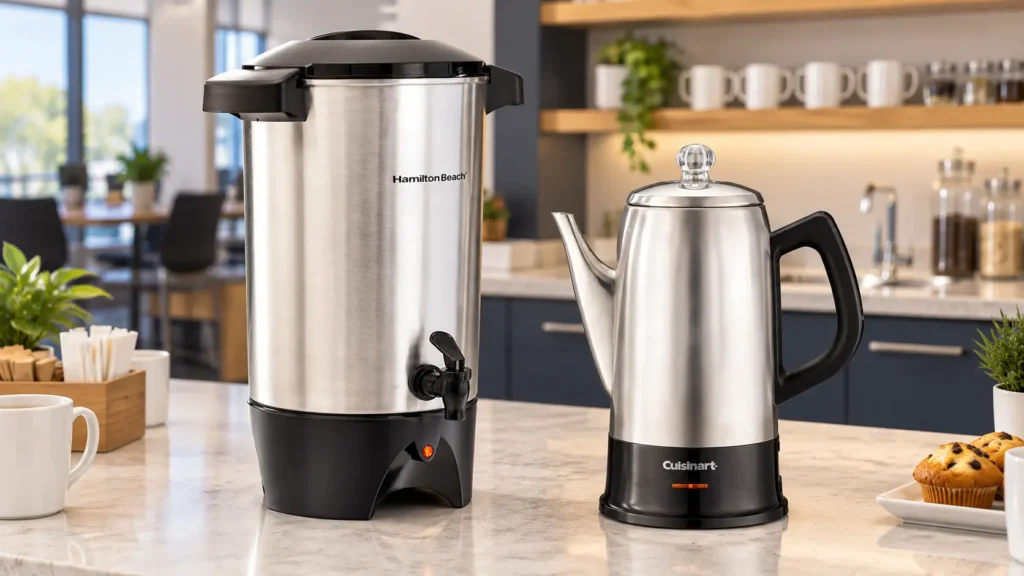
Best Office Percolators by Team Size
Small office (2 to 6 people): Presto 02811 12-Cup Electric Percolator
The Presto brews 2 to 12 cups at about one cup a minute. It keeps coffee hot on its own once brewing finishes. The body, basket and perk tube are all stainless steel, and it runs on 800 watts, so it won’t overload a small kitchen circuit.
- Pros: fast, all stainless steel, signal light when ready, 1-year warranty
- Cons: 12 “cups” is about 6 real mugs, so a team of 6 will brew twice a day
If you’re choosing between small brands, see our comparison of Hamilton Beach vs Presto percolators, what we love and hate about the Presto 12-cup, and our Farberware coffee percolator reviews.
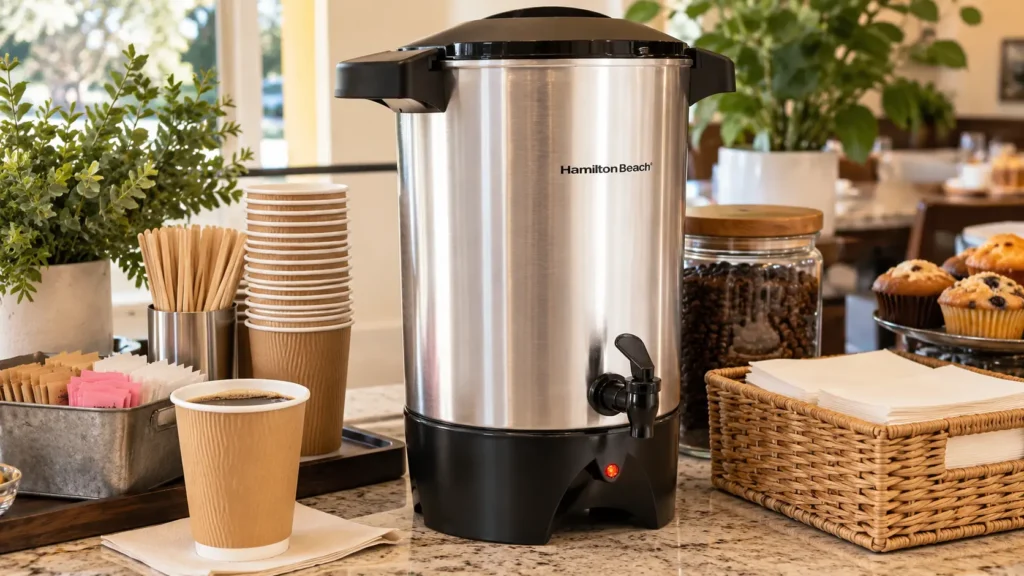
Mid-size office (8 to 20 people): SYBO SR-CP-50B 50-Cup Percolating Urn
This is a true percolating urn that holds 8 liters, or about 25 real mugs. It’s made of 304 stainless steel, the same grade used in restaurant equipment, and it’s ETL certified. It has keep-warm and auto shut-off, and SYBO offers up to a 2-year warranty if you register it.
- Pros: right size for a morning rush, stainless body, safety certified, no paper filters needed
- Cons: takes more counter space than a drip machine, and the exterior gets hot
Large office or events (20+ people): SYBO SR-CP-100B 100-Cup Percolating Urn
This is the bigger version of the 50-cup model: 16 liters, 304 stainless steel and ETL certified. SYBO says it brews a full 100 cups in about 40 minutes. It fits teams of 20 or more, training days and client events.
- Pros: big capacity, fast for its size, keep-warm and auto shut-off
- Cons: a full batch sitting all day goes bitter; for steady all-day drinking, brew half batches
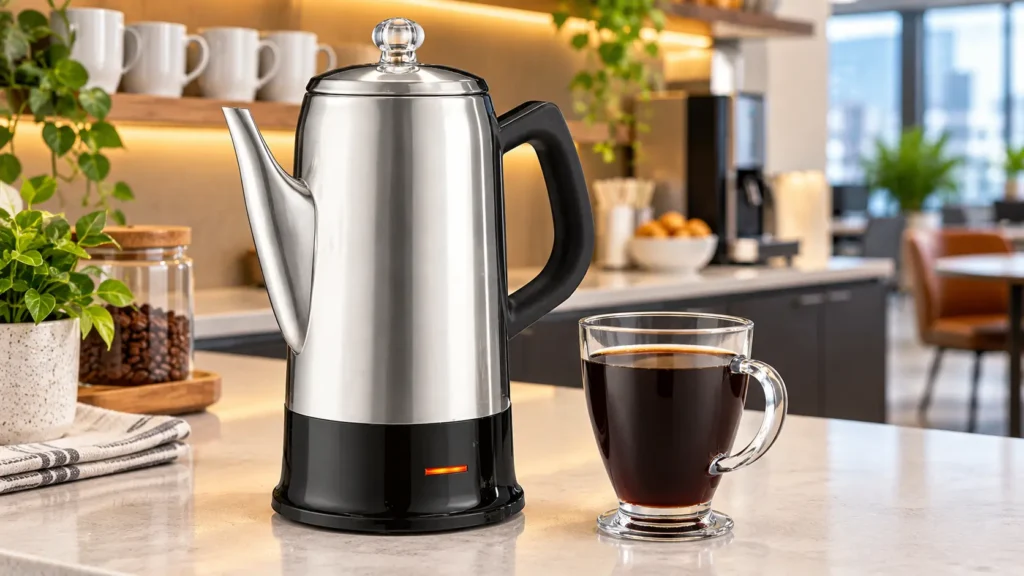
Budget commercial pick: West Bend 33600 100-Cup Urn
This West Bend is a restaurant-supply staple. It brews 40 to 100 cups at about a cup a minute and carries NSF and cULus marks, which matters if a health inspector checks your kitchen or you cater for clients. The body is polished aluminum, not stainless steel, and it draws 1,500 watts. More on the brand in 10 secrets about West Bend percolators.
- Pros: NSF certified, holds heat automatically, dripless tap, 1-year warranty
- Cons: aluminum can discolor and pit over time, and it needs a circuit of its own
What Size Percolator Does Your Office Need?
Percolator “cups” are about 5 ounces. Most people fill a 10 ounce mug, so cut the number on the box in half to get real mugs.
To work out your size, multiply your coffee drinkers by 2 mugs, then by 2 again to turn mugs into percolator cups. Twenty people need about 80 cups a day.
| Coffee drinkers | Percolator size (cups) | Real mugs per batch | Plan |
|---|---|---|---|
| 2 to 6 | 12 | about 6 | Brew 1 to 2 times a day |
| 8 to 15 | 30 to 50 | 15 to 25 | One morning batch, a small one after lunch |
| 15 to 30 | 50 to 100 | 25 to 50 | Brew half batches twice a day |
| 30+ or events | 100 | about 50 | One full batch per event |
Count coffee drinkers, not staff. A 10 person team where half drink tea needs less than a 5 person office that serves visiting clients.
Brew Time and How Much Coffee to Use
Small percolators brew about one cup a minute. Big urns take 40 minutes or more, so start them before people arrive.
| Batch size (cups) | Brew time | Ground coffee |
|---|---|---|
| 12 | 8 to 12 min | 3/4 cup (12 tbsp) |
| 30 | 20 to 30 min | 1 3/4 to 2 cups |
| 50 | 30 to 40 min | 2 1/2 to 3 cups |
| 100 | 40 to 60+ min | 5 to 5 1/2 cups |
Small percolators use about 1 tablespoon per cup. Big urns use a bit less per cup because the grounds sit in a deep basket and extract longer. Treat these numbers as a starting point, and check the markings on your urn’s basket, since every maker is a little different.
A few rules make the biggest difference:
- Grind coarse. It should look like coarse sea salt. Fine grinds slip through the basket and turn bitter.
- Don’t fill past the basket rim. An overfilled basket floods and sends grounds into the coffee.
- Mark a scoop. Keep a labeled measuring cup in the breakroom so everyone brews the same.
More detail: coffee-to-water ratios in percolators and how long to perk coffee.
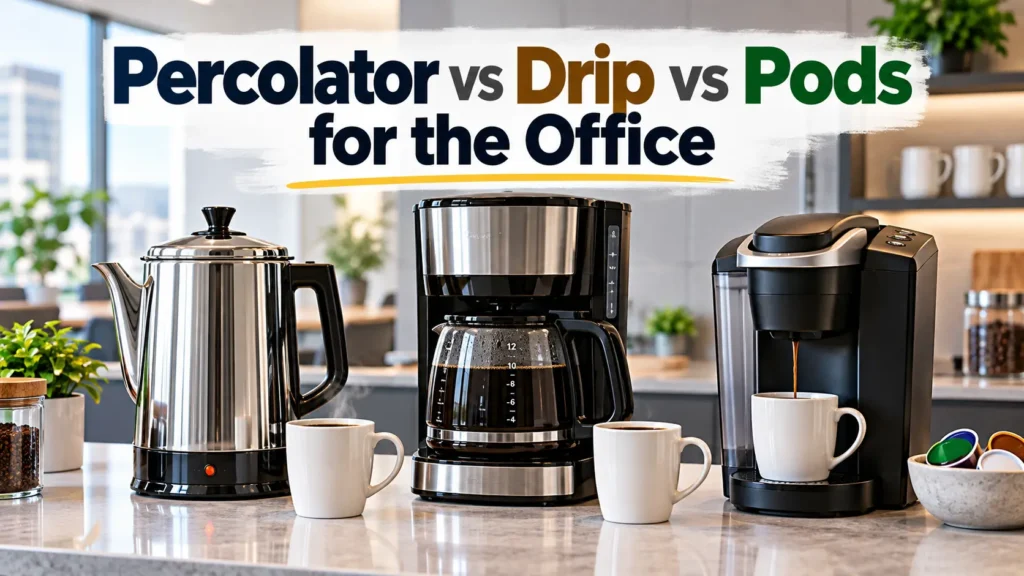
Percolator vs Drip vs Pods for the Office
For teams of 15 or more, a percolating urn is the cheapest and simplest way to serve coffee. Drip machines suit small teams, and pods cost the most.
| Factor | Percolating urn | Drip machine | Pod machine | French press |
|---|---|---|---|---|
| Batch size | 12 to 100 cups | about 12 cups | 1 cup | 4 to 6 mugs |
| Cost per 10 oz mug (USD, estimate) | 20 to 30 cents | 20 to 30 cents | 50 cents to $1+ | 20 to 30 cents |
| Keeps coffee hot | Yes, built in | Hot plate, scorches | No | No |
| Taste | Full, bold | Clean, medium | Varies | Full, some sediment |
| Daily cleanup | Dump basket, rinse | Toss filter | Toss pod | Scrape grounds, wash screen |
The cost estimate assumes ground coffee at $10 to $15 a pound, and about 1 pound for a full 100-cup batch. Pods add up fast: 20 people drinking 2 pods a day at 75 cents is about $7,500 a year over 250 workdays. The same coffee from an urn costs well under half that.
- Choose a drip machine if you have fewer than 8 people and prefer a lighter cup.
- Choose a percolating urn if you have 15 or more people, serve clients, or run events.
For small teams that like a hands-on brew, see electric percolator vs French press.
Why Office Percolator Coffee Turns Bitter (and How to Fix It)
Bitter percolator coffee almost always comes from over-extraction: the grind is too fine, it perked too long, or it sat on heat too long. Work through these in order:
- Grind coarser. Pre-ground coffee made for drip machines is too fine for a percolator.
- Never re-perk. Running finished coffee back through the grounds makes it bitter fast.
- Clean the urn. Old coffee oils go rancid and spoil every new batch. This is the step most offices skip.
- Use cold, filtered water. Very hard water or water from the hot tap changes the taste.
- Pick a medium roast. Very dark, oily roasts taste harsh in a percolator and clog the basket.
How long can coffee stay on keep-warm?
About 1 to 2 hours. Keep-warm holds the temperature without brewing again, but heat keeps breaking down the flavor. After two hours, brew a fresh batch or move the coffee to an insulated airpot.
For safety, never let an urn run dry on its heating element. Empty it, clean it and unplug it at the end of the day, and keep the cord away from hot surfaces. The Electrical Safety Foundation’s kitchen tips also recommend plugging countertop appliances into GFCI-protected outlets. Auto shut-off is a backup, not a replacement for turning it off.
More help: how to make percolator coffee not bitter and, for the opposite problem, why your percolator makes weak coffee. Buying pre-ground? See the best pre-ground coffee for percolators.
Material, Safety Marks and Power
For an office, pick 304 stainless steel with an ETL, UL or NSF mark, and plug it into its own outlet.
| Material | Good | Watch out for | For the office? |
|---|---|---|---|
| 304 stainless steel | Durable, no metallic taste, holds heat | Outside gets hot unless double-walled | Best choice |
| Aluminum | Light, cheaper, heats fast | Can pit and discolor over time | Fine on a budget |
| Glass | You can watch it brew | Breaks, loses heat | Home only |
- ETL or UL means an independent lab tested the electrical safety. Intertek explains the ETL Listed Mark as proof a product meets North American safety standards.
- NSF means it meets commercial food equipment standards for materials, cleanability and performance (NSF food equipment certification). Get this if your kitchen gets inspected or you cater for clients.
- Power: a 100-cup urn like the West Bend 33600 draws 1,500 watts. That’s about as much as a microwave. Running both on one circuit can trip the breaker, so plug the urn straight into its own wall outlet with no extension cord or power bar, as the Electrical Safety Foundation recommends for heat-producing appliances.
Stovetop percolators have no keep-warm and need someone watching the burner, so they don’t suit a shared breakroom. If you still want one, read our guide on how to buy a stovetop coffee percolator and our overview of different kinds of percolators.
Cleaning Routine for an Office Percolator
Rinse it after every batch and descale it once a month. Put one person’s name on it each week, or nobody will do it.
Every day
- Unplug the urn and let it cool.
- Dump the grounds, then rinse the basket, stem and lid.
- Wipe the inside with a soft cloth. Don’t use steel wool on stainless.
- Leave the lid off overnight so it dries.
Every week
- Wash the basket and stem with dish soap and a bottle brush.
- Clean the tap. Coffee sludge builds up inside it.
Every month
- Fill it with 1 part white vinegar to 3 parts water, run a full cycle, and pour it out. Then run two cycles of plain water.
- Check the cord, plug and tap seal for damage.
Don’t put the base in water or the dishwasher. It can ruin the heating element and void the warranty.
Step-by-step guides: how to clean an electric percolator and 11 ways to clean your coffee percolator.
FAQ
Is a coffee urn the same as a percolator?
Only if it percolates. Many large urns do, but some are drip brewers or hot water dispensers. Look for “percolate” or a center perk tube in the listing.
How many mugs does a 100-cup percolator make?
About 50 mugs of 10 ounces. Percolator cups are measured at about 5 ounces.
What’s the best percolator for a 10-person office?
A 30 to 50 cup percolating urn, such as the SYBO SR-CP-50B. It covers the morning rush in one batch.
Do I need paper filters?
Usually not. The metal basket does the job. A filter disc helps only if your grind is too fine. More in our guide on whether you need a filter for a percolator.
Is percolator coffee stronger than drip?
It tastes fuller because the water passes through the grounds several times. Caffeine depends mostly on how much coffee you use.
How long does an office percolator last?
A stainless steel urn that’s cleaned regularly usually lasts several years. The heating element and the tap seal tend to fail first, so a real warranty matters.
The Bottom Line
Size the percolator to your coffee drinkers, not your headcount. Buy stainless steel with a safety mark, and brew smaller batches more often instead of one big batch that sits all day.
- Count demand: coffee drinkers × 2 mugs × 2 = percolator cups per day.
- Pick the size: 12 cups for up to 6 people, 30 to 50 for up to 20, and 100 for bigger teams and events.
- Buy coarse-ground medium roast in bulk and keep a marked scoop in the breakroom. Store the bag airtight and away from heat and light, as the National Coffee Association advises.
- Post a brew card by the urn: how much coffee, brew time, the 2-hour keep-warm limit, and the cleaning schedule.
- Rotate cleanup weekly. Clean equipment does more for taste than any upgrade.
Still comparing features? Our checklist on how to choose the best coffee percolator covers what to look for.